


How Much Is a Car Accident Claim Worth in Colorado?
Nobody can tell you what your car accident claim is worth from a headline number, and anyone who does is guessing. What we can tell you is exactly what goes into that number in Colorado: which damages are uncapped, which are capped and at what dollar figure, how the state’s fault rule shrinks a claim, where the insurance money actually comes from, and the two deadlines that quietly decide more cases than any courtroom.
This guide walks through each piece, with the statutes behind it, from a Denver firm that has recovered $550 million+ for Colorado injury clients.
The Short Answer
A Denver car accident lawyer can help determine what your Colorado car accident claim may be worth. A Colorado car accident claim is worth the sum of your economic damages (medical bills, lost income, property damage, and future care), which have no cap, plus your noneconomic damages (pain and suffering and loss of enjoyment of life), which are capped at $1,500,000 for claims accruing on or after January 1, 2025, minus any percentage of fault assigned to you, and limited in practice by the insurance available to pay it.
Everything below explains each of those terms and how they move the number.
For a free legal consultation, call (303) 465-8733
What Counts as Damages in a Colorado Car Accident Claim
Economic damages (no cap):
- Emergency care, hospitalization, surgery, imaging, and follow-up treatment
- Physical therapy, chiropractic care, and pain management
- Future medical costs for injuries that need ongoing or lifetime care
- Lost wages while you recover, and lost earning capacity if you cannot return to your prior work
- Vehicle repair or replacement and other property damage
- Out-of-pocket costs: prescriptions, mileage to appointments, household help
Noneconomic damages (capped):
- Pain and suffering
- Inconvenience, emotional stress, and impairment of quality of life
- Loss of enjoyment of life
Physical impairment and disfigurement sit in their own category under Colorado law and are not subject to the general noneconomic cap. For a crash that leaves someone with a permanent limp, a surgical scar, or a lost range of motion, that distinction can matter more than anything else on this page.
Colorado’s 2026 Damages Caps for Car Accident Claims
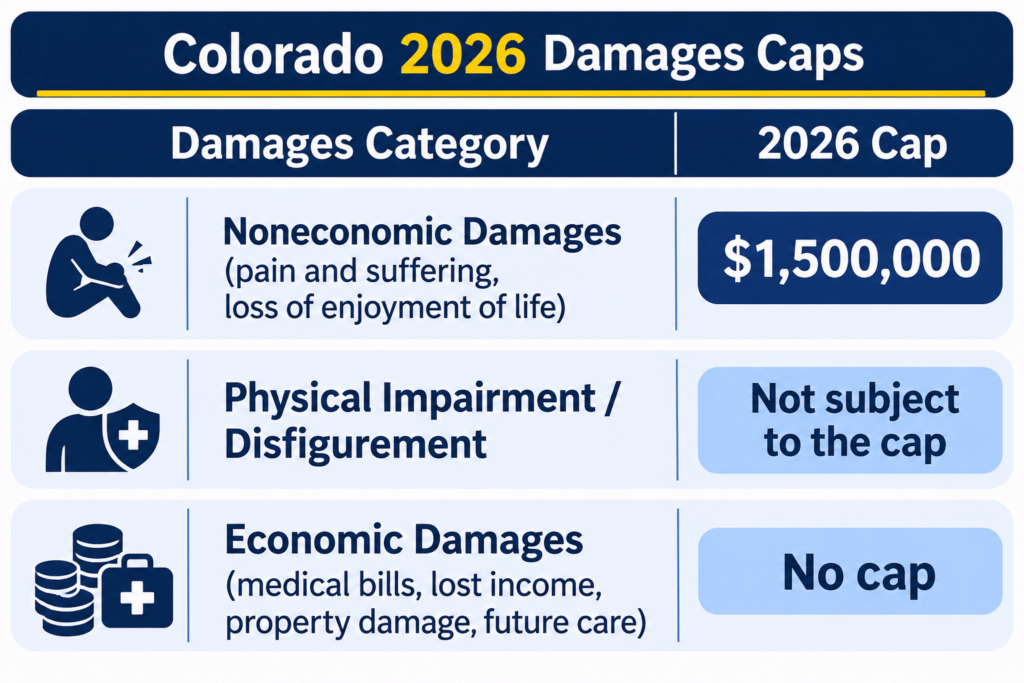
The $1,500,000 figure comes from HB24-1472, which amended C.R.S. § 13-21-102.5. It applies to civil actions filed on or after January 1, 2025 and to any claim that accrues on or after that date. The cap will be adjusted for inflation on January 1, 2028 and every two years after that. Before this law, the general noneconomic cap had sat at a fraction of this amount for years, so if you are comparing your situation to a friend’s settlement from 2022, the rules have changed in your favor.
How Fault Changes What Your Claim Is Worth
Colorado is an at-fault state, which means the driver who caused the crash (through their insurer) is responsible for the harm. It is not a no-fault state, and there is no requirement to claim against your own policy first.
Fault is rarely all-or-nothing. Colorado uses modified comparative negligence under C.R.S. § 13-21-111: your recovery is reduced by your percentage of fault, and if you are found 50% or more at fault, you recover nothing. A $200,000 claim with 20% fault assigned to you becomes a $160,000 claim. At 50%, it becomes zero.
This is where the insurance adjuster earns their salary. Expect arguments that you were speeding, following too closely, distracted, or could have avoided the crash. Every percentage point they attach to you comes directly off the top of your settlement, which is why fault evidence, including how to get a Denver police accident report, dash-cam or intersection footage, witness statements, and vehicle damage patterns, is worth securing early.
The Seat Belt Rule
Colorado has a specific wrinkle here. Under C.R.S. § 42-4-237, evidence that you were not wearing a seat belt is admissible to reduce your damages, but only your damages for pain and suffering. It cannot be used to reduce your economic losses or medical expenses. If you were unbelted, your claim is not gone, but the noneconomic portion of it is exposed.
Where the Money Comes From: Colorado Insurance Limits
A claim is only worth what can actually be collected, and in a car accident that usually means insurance.
The at-fault driver’s liability policy. Colorado’s minimum required liability coverage under C.R.S. § 10-4-620 is $25,000 per person for bodily injury, $50,000 per accident for bodily injury, and $15,000 for property damage. A single emergency room visit with imaging can approach the per-person minimum. Many Colorado drivers carry only the minimum, and a meaningful number carry nothing at all.
Your own uninsured/underinsured motorist (UM/UIM) coverage. When the at-fault driver has too little insurance, fled the scene, or had no coverage, your own UM/UIM policy can cover the gap. Colorado insurers must offer UM/UIM coverage in amounts equal to your liability limits under C.R.S. § 10-4-609, and you have to reject it in writing to not have it. Check your declarations page before assuming you do not have it.
Medical payments (MedPay) coverage. Colorado insurers must offer at least $5,000 in MedPay under C.R.S. § 10-4-635, and it is included unless you rejected it. It pays medical bills regardless of fault and does not reduce your claim against the at-fault driver.
Commercial, rideshare, and employer policies. If the other driver was working, driving for a rideshare platform, or operating a company vehicle, higher commercial limits may be in play. These cases are worth more because there is more coverage, and they are also fought harder.
Your own insurer’s conduct. A Denver bad faith insurance lawyer can help you pursue a claim if your own insurance company unreasonably delays or denies a UM/UIM or MedPay benefit. Colorado law gives you a separate claim in these situations. Under C.R.S. § 10-3-1116, a first-party claimant whose benefits were unreasonably delayed or denied can recover two times the covered benefit, plus reasonable attorney fees and costs. That statute changes how insurers behave once a lawyer is involved.
The 30-Day Rule Most Crash Victims Have Never Heard Of
If the insurance company called you the day after your crash with a settlement offer, Colorado law has something to say about that.
Under C.R.S. § 13-21-301, while an injured person is under a doctor’s care or hospitalized, anyone with an adverse interest (the other driver’s insurer, for example) may not negotiate a settlement or obtain a release of liability within 30 days of the injury, and may not take a statement from the injured person for use in settling the claim within 15 days. A settlement or release obtained in violation is void. A statement taken in violation cannot be used against you.
Why does this matter to claim value? Because the quickest way to turn a six-figure claim into a four-figure one is to sign a release before you know what your injuries are. Soft-tissue injuries, concussions, and disc injuries routinely take weeks to show their full extent. The 30-day rule exists because insurers know that too.
Click to contact our personal injury lawyers today
Deadlines That Decide Car Accident Claims in Colorado
- Lawsuit against the at-fault driver: three years from the date of the crash, under C.R.S. § 13-80-101(1)(n), which covers tort actions for bodily injury or property damage arising out of the use or operation of a motor vehicle. This is longer than the two-year deadline for most other Colorado negligence claims, and it is the one that applies to a typical car crash.
- Claims involving a government vehicle or dangerous road design: if a city, county, RTD, or state vehicle was involved, or a defective signal or road condition contributed, the Colorado Governmental Immunity Act requires written notice within 182 days of the injury. Miss it and the claim is gone, regardless of the three-year window.
- Insurance notice deadlines: your own policy will have its own notice requirements for UM/UIM and MedPay claims. Read them, or have us read them, early.
Factors That Move a Colorado Car Accident Settlement Up or Down
-
Injury severity and permanency. Fractures, surgeries, traumatic brain injury, and spinal injuries push claims toward the cap and, through uncapped economic and impairment damages, well beyond it.
-
Medical documentation. Gaps in treatment are the adjuster’s favorite exhibit. Consistent, documented care is both better medicine and a stronger claim.
-
Clarity of fault. A rear-end collision at a red light on Colfax reads very differently to an adjuster than a disputed lane-change on I-25.
-
Available coverage. Minimum-limits defendants cap a claim in practice at $25,000 unless UM/UIM or another policy comes into play.
-
Comparative fault. Every point assigned to you is a direct reduction.
-
Lost income and earning capacity, especially for self-employed and hourly workers whose losses are real but harder to document.
-
Venue. A Denver case is heard in Denver District Court (Second Judicial District); a crash in Centennial or Aurora typically lands in Arapahoe County (Eighteenth Judicial District). Claims under $25,000 can be brought in county court. Juries and judges differ by county, and experienced local counsel prices that in.
-
How attorney contingency fees work in Colorado. Most car accident lawyers, including a Denver car accident lawyer, work on a contingency-fee basis. This means you generally do not pay attorney fees upfront. Instead, the lawyer receives an agreed-upon percentage of your settlement or verdict if the case is successful. The fee percentage and responsibility for case expenses should be clearly explained in your written fee agreement.
-
Whether your car accident settlement is taxable. In most cases, compensation received for physical injuries or physical sickness, including related medical expenses, lost income, and pain and suffering, is not subject to federal income tax. However, portions awarded as punitive damages or interest may be taxable. The tax treatment depends on the type of compensation and the circumstances of your settlement, so consult a qualified tax professional about your specific situation.
Complete a Free Case Evaluation form now
FAQ
How much is the average car accident settlement in Colorado?
There is no reliable average, because the range runs from a few thousand dollars for a minor soft-tissue injury with a quick recovery to well into seven figures for a crash causing permanent impairment. What is knowable is the formula: uncapped economic damages, plus noneconomic damages capped at $1,500,000 for claims accruing on or after January 1, 2025, plus physical impairment and disfigurement damages outside the cap, reduced by your percentage of fault and limited by the insurance available.
Can I still recover if I was partly at fault for the car accident?
Yes, as long as you were less than 50% at fault. Under Colorado’s modified comparative negligence rule, C.R.S. § 13-21-111, your recovery is reduced by your percentage of fault. At 50% or more, you recover nothing.
What is the minimum car insurance in Colorado, and what happens if the other driver only has that?
Colorado requires at least $25,000 per person and $50,000 per accident in bodily injury liability coverage and $15,000 in property damage coverage under C.R.S. § 10-4-620. If the at-fault driver carries only the minimum, your own uninsured/underinsured motorist coverage is usually the next source of recovery.
How long do I have to file a car accident lawsuit in Colorado?
Three years from the date of the crash for claims against another driver, under C.R.S. § 13-80-101(1)(n). If a government vehicle or dangerous road condition was involved, you must give written notice within 182 days under the Colorado Governmental Immunity Act.
The insurance company offered me a settlement a week after my crash. Should I take it?
Not without talking to a lawyer. Under C.R.S. § 13-21-301, while you are under a doctor’s care, the other side may not negotiate a settlement or obtain a release within 30 days of the injury, and any release obtained in violation is void. Early offers are made before the full extent of your injuries is known, which is exactly why the law restricts them.
Does not wearing a seat belt hurt my Colorado car accident claim?
It can reduce your pain and suffering damages, but under C.R.S. § 42-4-237 it cannot be used to reduce your economic losses or medical expenses. Your claim is not barred.
Conclusion
The value of a Colorado car accident claim is not a mystery, but it is a calculation with several moving parts: uncapped economic losses, a $1,500,000 noneconomic cap with impairment damages outside it, a fault rule that subtracts your share, and insurance limits that set the practical ceiling. Getting each of those right, early, is the difference between what a claim is worth and what it settles for.
Jordan Law Accident & Injury Lawyers has recovered $550 million+ for Colorado injury clients. Consultations are free, there is no fee unless we win, and we will tell you plainly what we think your claim is worth. Call (303) 465-8733.