


There’s no single number that answers this question honestly, and any site that gives you one flat figure is guessing. Colorado wrongful death claims range from settlements in the low six figures to multi-million-dollar verdicts, and the gap between them comes down to a short list of specific, knowable factors: who died, who they supported, who was at fault, and what Colorado law allows you to recover.
This guide breaks down exactly how Colorado calculates wrongful death damages, what the state’s 2026 damages caps actually are, who has the legal right to file, and the deadlines that can end a claim before it starts — from a firm that has recovered over $550 million for Colorado families.
What Makes Up a Wrongful Death Settlement in Colorado
Colorado divides wrongful death damages into two categories, and understanding the split matters because only one of them is capped by law.
Economic damages (uncapped):
- The financial support your loved one would have provided over their expected lifetime
- Lost benefits — health insurance, retirement contributions, and other household income sources
- Loss of household services (childcare, home maintenance, caregiving)
- Funeral and burial expenses
- Medical and hospital bills incurred between the injury and death
Noneconomic damages (capped — see below):
- Grief, sorrow, and mental anguish
- Loss of companionship, guidance, and consortium
- Impairment of the quality of the surviving family’s relationship with the deceased
In practice, economic damages tend to drive settlement value in cases involving a primary breadwinner or a parent of young children, since a lifetime of lost financial support and childcare can run into the millions with no statutory ceiling. Noneconomic damages matter in every case, but they’re the category Colorado law limits.
For a free legal consultation, call (303) 465-8733
Colorado’s Wrongful Death Damages Cap (Updated for 2026)
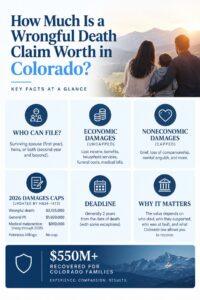
House Bill 24-1472 substantially raised Colorado’s damages caps, and the new limits apply to any civil action filed on or after January 1, 2025 — including claims still working through the courts in 2026.
| Damages Category | 2026 Cap |
| Wrongful death (noneconomic damages) | $2,125,000 |
| General personal injury (noneconomic damages) | $1,500,000 |
| Medical malpractice wrongful death | $810,000 (rising on a five-year schedule through 2029) |
| Felonious killings | No cap |
| Economic damages (all case types) | No cap |
A few things worth knowing:
- These caps replace Colorado’s old wrongful death limit of roughly $600,000 — a significant increase for families with claims filed in 2025 or later.
- Biennial inflation adjustments to the general caps begin January 1, 2028, so the $2,125,000 figure will start climbing every two years after that.
- If the death resulted from a felony (vehicular homicide while intoxicated, for example), the noneconomic damages cap doesn’t apply at all.
- The cap only touches noneconomic damages. A young parent’s lost lifetime earnings and benefits — the economic side of the claim — are never limited by these numbers, which is why catastrophic wrongful death cases regularly settle well above the cap once economic losses are added in.
Who Can File a Wrongful Death Claim in Colorado
Colorado’s Wrongful Death Act (C.R.S. §§ 13-21-201 to 204) controls who has legal standing to bring the claim, and the answer changes depending on how much time has passed since the death.
First year after death: The surviving spouse has exclusive priority. They can sue alone, elect to sue jointly with the deceased’s heirs, or step aside and let the heirs bring the claim instead.
Second year and beyond: Standing opens up to the spouse, the heirs, or both together. If a designated beneficiary exists under Colorado law, they can join the case too. When heirs file first, a spouse or designated beneficiary can still join as a party by motion within 90 days of being served notice.
If the deceased was an unmarried minor with no children: Both parents can bring the claim, generally with equal interests, though a court can apportion the recovery between divorced or separated parents based on their actual relationship with the child.
What changed in 2025–2026: HB24-1472 gave siblings narrow, conditional standing to file — but only when there is no surviving spouse, no surviving descendants, and no surviving parent. It’s a real expansion of who can seek justice, but it’s a last-resort right, not a general one.
How Fault Affects Your Wrongful Death Recovery
Colorado follows a modified comparative negligence rule under C.R.S. § 13-21-111. If the deceased is found partially at fault for the incident that caused their death, the family’s recovery is reduced by that percentage — and if they’re found 50% or more at fault, the claim recovers nothing.
This is exactly why defendants and their insurers spend so much effort trying to shift blame onto the deceased, including designating other parties at fault within 90 days of a lawsuit under C.R.S. § 13-21-111.5. Early investigation — accident reconstruction, witness statements, and physical evidence preserved before it disappears — is often what keeps a fault percentage from creeping toward that 50% cutoff.
Deadlines to File a Wrongful Death Claim in Colorado
- General deadline: Two years from the date of death, under C.R.S. § 13-21-204.
- Vehicular homicide cases: Extended to four years after the death.
- Government defendants: If a government vehicle or entity contributed to the death, the Colorado Governmental Immunity Act requires written notice within 182 days — far shorter than the general filing deadline, and it runs regardless of when the lawsuit itself is filed.
- Evidence deadlines that aren’t in any statute: Commercial vehicle data recorders, surveillance footage, and physical evidence can be lawfully destroyed or overwritten within weeks to months. The practical window to protect a case is often much shorter than the legal filing deadline.
Click to contact our personal injury lawyers today
What Actually Moves a Wrongful Death Settlement Up or Down
Beyond the caps and the filing rules, a handful of case-specific factors do most of the work in determining what a claim is actually worth:
- Clarity of liability. A drunk-driving crash with a police report and toxicology results settles differently than a disputed liability case.
- Available insurance and number of defendants. Commercial vehicles, multi-defendant premises cases, and product liability claims often carry far more coverage than a single at-fault driver’s minimum auto policy.
- The decedent’s earning capacity and age. A 35-year-old with dependents and 30 working years ahead has a larger economic damages calculation than the caps alone would suggest.
- Number and age of surviving dependents, particularly minor children who lost a parent’s day-to-day care and guidance.
- Documented relationship and household role — testimony, photos, and records that establish what the family actually lost, not just what a formula estimates.
- Venue and the specific court where the case would be tried.
FAQ
How much is the average wrongful death settlement in Colorado?
There’s no reliable average, because wrongful death outcomes vary enormously based on the deceased’s income, age, and number of dependents, along with liability and available insurance. Cases involving a primary wage earner or young children commonly settle well into six or seven figures once lost lifetime financial support is calculated, while the noneconomic portion of any 2025-or-later claim is capped at $2,125,000 unless a felony was involved.
What is Colorado’s cap on wrongful death damages in 2026?
For civil actions filed on or after January 1, 2025, Colorado caps noneconomic wrongful death damages — grief, loss of companionship, loss of consortium — at $2,125,000. That cap doesn’t apply to felonious killings, and it doesn’t touch economic damages like lost financial support, lost benefits, or funeral costs, which remain uncapped. Medical malpractice wrongful death claims follow a separate, lower schedule that reaches $810,000 in 2026.
Who can file a wrongful death lawsuit in Colorado?
In the first year after death, the surviving spouse has exclusive priority to file. After one year, the spouse, heirs, or a designated beneficiary can bring the claim, and as of HB24-1472, siblings can file in the narrow case where no spouse, descendants, or parents survive. Parents of an unmarried minor without children of their own can also bring the claim.
How long do I have to file a wrongful death claim in Colorado?
Generally two years from the date of death under C.R.S. § 13-21-204, extended to four years in vehicular homicide cases. If a government entity is involved, a separate 182-day notice deadline under the Colorado Governmental Immunity Act applies on top of the filing deadline — and it’s much shorter, so it shouldn’t be treated as an afterthought.
Can my family still recover if our loved one was partly at fault?
Yes, as long as they’re found less than 50% at fault. Under Colorado’s modified comparative negligence rule, C.R.S. § 13-21-111, the recovery is reduced by their percentage of fault, and at 50% or more the claim recovers nothing. Insurers routinely try to push that percentage up, which is why early investigation matters.
Complete a Free Case Evaluation form now
Conclusion
Colorado’s wrongful death caps went up substantially in 2025, the list of who can file expanded in a narrow but real way, and the deadlines that govern these claims are shorter and less forgiving than most families expect. None of that changes what actually determines a settlement’s value in your specific case — that still comes down to liability, insurance, and what your family actually lost.
If you’ve lost a loved one to someone else’s negligence, contact Denver wrongful death lawyer who offers free, no-obligation consultations and has recovered more than $550 million for Colorado families. There’s no fee unless we win.