
You just got hit by someone with no insurance. Maybe it happened at the Arapahoe Road and I-25 interchange during evening rush hour. Maybe you were pulling out of a parking lot near the Landmark shopping area. Your adrenaline is up. Your hands are shaking. And the other driver just told you they don’t have coverage.
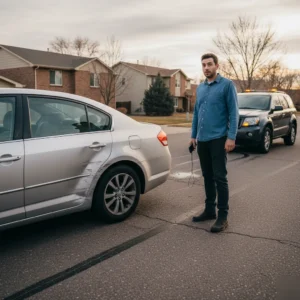
Stop. Breathe. What you do in the next 30 minutes shapes your entire case.
People who take the right steps at the scene recover more money. People who panic, skip documentation, or drive away with just a phone number end up fighting uphill for months. Here’s what you need to do, in order.
Call 911 and get a police report. This is not optional. In Colorado, a police report creates an official record of the crash. It documents the other driver’s lack of insurance. It captures witness statements while memories are fresh. The Greenwood Village Police Department will respond to accidents within city limits, and that report becomes one of the most important pieces of evidence you’ll have. Without it, your own insurance company will question everything.
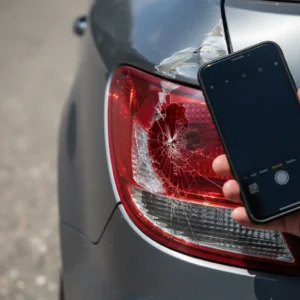
Document everything yourself. Don’t rely only on the police. Pull out your phone. Take photos of both vehicles from every angle. Capture the license plate of the other car. Photograph the intersection, any skid marks, traffic signals, and road conditions. Get wide shots showing where the cars ended up. If there’s damage to a guardrail or street sign, photograph that too. Phone photos have proven that other drivers ran red lights when police reports were inconclusive.
Get the other driver’s information even though they’re uninsured. You still need their full name, address, phone number, and driver’s license number. Write down the make, model, year, and color of their vehicle. An uninsured motorist accident lawyer will need this to go after every available source of recovery.
Talk to witnesses. Anyone who saw the crash. Get names and phone numbers. People forget details fast — they move away, they stop returning calls. A witness statement taken at the scene is worth ten times more than one taken three weeks later.
Seek medical attention right away. Even if you feel okay. Adrenaline masks pain. Soft tissue injuries, concussions, and whiplash often don’t show up for 24 to 48 hours. Go to Sky Ridge Medical Center or an urgent care clinic that same day. Insurance companies love to argue that if you didn’t seek treatment right away, you weren’t really hurt. Don’t give them that argument.
Here’s something most people don’t realize until it’s too late. Do not apologize at the scene. Do not say “I’m sorry” or “I should have seen you.” Colorado follows modified comparative negligence under C.R.S. § 13-21-111. If the insurance company can pin 50% or more of the fault on you, your recovery drops to zero. A simple apology can be twisted into an admission of fault.
The scene is where your case begins. Not in a courtroom. Not in a lawyer’s office. Right there on the pavement.
What to Do If Police Were Not Called to the Scene
This happens more than you’d think. The other driver says they’ll handle it. Maybe the crash seemed minor at first. You swap phone numbers and everyone drives off. Then you get home and your neck hurts. Or you find out the number they gave you is fake.
Now you’re dealing with an uninsured driver and you have no police report to back up your story. Not having a police report doesn’t mean your claim is dead. It means you need to move fast and build your own evidence.
The Greenwood Village Police Department lets you file a report after the fact. Call their non-emergency line and explain what happened. Give them every detail you remember — the location, the time, the other car’s color and make. Even partial plate numbers help. That delayed report won’t carry the same weight as one filed at the scene, but it still creates an official record tying the other driver to the crash.
Build Your Own Paper Trail

Without a police report, your case depends on what you can document yourself. Start with your phone. Write down everything you remember while it’s fresh — the street you were on, which direction each car was heading, what the other driver said to you. Did they admit fault? Did they say they didn’t have insurance? Those details matter.
Go back to the scene if you can do it safely. Look for nearby businesses with security cameras. Along Arapahoe Road and the DTC corridor, there are office buildings and retail spots with cameras pointed at parking lots and intersections. But that footage gets overwritten fast — sometimes within 48 to 72 hours. You can’t wait a week to ask.
Your phone’s location history can place you at the scene at a specific time. Dashcam footage from your own vehicle is even better. And if any witnesses stopped or saw what happened, their statements become critical when there’s no official report. Get names and numbers before they walk away.
Your Insurance Company Needs to Hear From You
File a claim with your own insurer right away. If you carry uninsured motorist coverage, that’s the policy that kicks in here. Colorado law under C.R.S. § 10-3-1116 gives you real leverage if your insurer acts in bad faith on a UM claim — including double damages plus attorney fees. But that protection only works if you’ve reported the crash and started the process.
Don’t assume your insurer is on your side just because you’ve been paying premiums for years. Your own insurer will look for reasons to minimize your payout. No police report gives them one more reason to push back. The more documentation you bring to the table, the harder it is for them to lowball you.
Colorado gives you three years from the date of a motor vehicle accident to file a lawsuit under C.R.S. § 13-80-101. That sounds like plenty of time. It’s not. Evidence disappears. Witnesses forget. The sooner you lock down your documentation, the stronger your position.
For a free legal consultation, call (303) 465-8733
Understanding Your Insurance Options After an Uninsured Driver Hits You
The other driver’s lack of insurance doesn’t mean you’re out of options. It means you need to look at your own policy. That shift catches people off guard — because they assume their insurance company is on their side. When it comes to a UM claim, your insurer is the one paying. So they act like the opposing party.
Uninsured motorist coverage (UM) is the policy you’ll file under. Colorado doesn’t require drivers to carry it, but many Greenwood Village residents have it on their policies without knowing. Check your declarations page — the summary document your insurer sends each renewal period. Look for “UM” or “uninsured motorist” with a dollar amount next to it. That number is your coverage limit.
Underinsured motorist coverage (UIM) is different. It kicks in when the at-fault driver has some insurance but not enough to cover your injuries. Along the I-25 corridor near the Arapahoe Road interchange, high-speed crashes routinely cause injuries that go far beyond minimum policy limits. About 15 percent of Colorado drivers carry no insurance at all. But plenty more carry only the state minimum of $25,000 per person. That disappears fast with one ER visit.
Stacking is another option most people miss entirely. If you have multiple vehicles on your policy, Colorado law may let you stack your UM coverage — meaning the limits multiply. Two cars with $100,000 in UM coverage could mean $200,000 available. Your insurer won’t bring this up on their own. You have to know to ask, or have someone ask for you.
MedPay is worth knowing about too. Medical payments coverage pays your bills regardless of fault. No deductible. No waiting for a claim to settle. It’s first-dollar coverage that can keep you in treatment while the UM claim works through the process. If you have it on your policy, use it right away.
Here’s where it gets adversarial. When you file a UM claim, your own insurance company will investigate you. They’ll request medical records going back years. They’ll argue your neck pain was pre-existing. They’ll send you to their own doctor for an “independent” medical exam that isn’t independent at all.
Insurance companies are counting on you not knowing this. If your insurer unreasonably delays or denies your UM claim, Colorado’s bad faith statute gives you real leverage. Under C.R.S. § 10-3-1116, you can recover double the covered benefit plus attorney fees. That’s not a theoretical threat. It changes how insurers behave when they know your attorney will actually enforce it.
We’ve helped clients right here in Greenwood Village find UM coverage they didn’t know existed. One couple had stacked coverage across three vehicles — giving them $300,000 in available limits after an uninsured driver ran a red light near the Landmark entertainment district. They had no idea until we pulled their policy apart.
Don’t let your own insurance company tell you what your claim is worth. That’s not their job. That’s yours.
Frequently Asked Questions
Do I have to file a police report after being hit by an uninsured driver in Greenwood Village?
Yes — filing a police report is one of the most important steps you can take. The Greenwood Village Police Department will respond to crashes within city limits. That report creates an official record that the other driver had no insurance. Without it, your own insurance company can question your version of events. If police were not called at the scene, you can still file a delayed report through the non-emergency line. A report filed later is not as strong, but it still creates a record tying the other driver to the crash.
What is uninsured motorist coverage and how does it help me in this situation?
Uninsured motorist (UM) coverage is a part of your own auto insurance policy that pays when the at-fault driver has no insurance. You file the claim with your own insurer, not the other driver’s. Colorado law under C.R.S. § 10-3-1116 gives you real protection if your insurer handles your UM claim in bad faith — including double damages and attorney fees. This is why reporting the crash right away matters. Waiting too long can weaken your claim. For a full breakdown of your recovery options, the parent page on uninsured motorist accident claims covers what you need to know.
Can I still recover money if I didn’t get a police report at the scene near an area like Arapahoe Road or the DTC corridor?
Yes, you can still pursue a claim — but you need to move fast. Security cameras on office buildings and retail spots along Arapahoe Road and the DTC corridor often capture crashes on video. That footage gets overwritten in as little as 48 to 72 hours. Go back to the scene quickly and identify nearby businesses with exterior cameras. Your phone’s location history, dashcam footage, and witness statements all help fill the gap left by a missing police report. Every hour you wait makes it harder to preserve that evidence.
Is it true that saying ‘I’m sorry’ at the scene can hurt my case?
Yes — even a casual apology can be used against you. Colorado follows modified comparative negligence under C.R.S. § 13-21-111. If an insurance company can show you were 50% or more at fault, your recovery drops to zero. An offhand “I’m sorry” said at the scene can be twisted into an admission of fault later. You do not need to argue with the other driver. Just stay calm, collect information, and let the official report and your documentation tell the story.
What is a common mistake people make after being hit by an uninsured driver in Greenwood Village?
The most common mistake is skipping medical care because you feel okay right after the crash. Adrenaline masks pain. Soft tissue injuries, whiplash, and concussions often don’t show up for 24 to 48 hours. If you wait several days to see a doctor, insurance companies will argue your injuries were not caused by the crash. Go to Sky Ridge Medical Center or an urgent care clinic the same day — even if you feel fine. That visit creates a medical record that connects your injuries directly to the accident.
How does Colorado’s modified comparative negligence rule affect my uninsured driver claim?
Colorado’s modified comparative negligence law means your payout is reduced by your share of fault. If you are found 20% at fault, you recover 80% of your damages. But if you are found 50% or more at fault, you recover nothing. This rule applies even when the other driver had no insurance. That’s why solid documentation at the scene — photos, witness names, an accurate police report — matters so much. The facts you capture right after the crash directly affect how much you can recover later.