
Short answer: yes. Colorado law does not require adult cyclists to wear helmets. No law broken means no automatic bar to your claim. But insurance companies will still try to use it against you, we see this play out constantly in Greenwood Village bicycle accident cases, and the tactics are always the same.
Colorado treats bicycles as vehicles under C.R.S. § 42-4-1412. That gives you the same road rights as any car or truck. There’s no state statute requiring adults to wear a helmet while riding. So if a driver runs a red light on Arapahoe Road and hits you while you’re riding without a helmet, your helmet status is completely separate from that driver’s negligence. Those are two different questions.
The real fight starts when the insurance adjuster gets involved.
Insurance companies count on you not knowing this. Their playbook is predictable: argue you were partly responsible for your own injuries because you chose not to wear a helmet, try to reduce what they owe you, and sometimes suggest your claim isn’t worth pursuing at all. That’s not how Colorado law works. Not even close.
How Comparative Negligence Enters the Picture
Colorado follows a modified comparative negligence rule under C.R.S. § 13-21-111. You can recover damages as long as you’re less than 50% at fault. At 50% or more, you get nothing. The insurance company knows that threshold, they build their entire defense strategy around pushing your fault percentage as high as possible.
Not wearing a helmet is one of their favorite tools. But here’s what actually matters. A helmet is irrelevant to whether the driver failed to give you the required three feet of passing space under C.R.S. § 42-4-1003. It plays no role in whether a distracted driver drifted into the bike lane along Orchard Road near the Denver Tech Center. The helmet question only becomes relevant if the defense can show your head injuries would have been less severe with one on, and even then, it’s a reduction argument, not a case killer.
That distinction matters more than most people realize.
What We’ve Seen in Real Cases
Here’s a scenario we’ve handled before. A cyclist crosses at a road intersection along the High Line Canal Trail in Greenwood Village, that stretch where it cuts through near Orchard Road. A driver blows through without stopping. The cyclist suffers a broken collarbone, road rash, and a concussion. No helmet.
The driver’s insurance company immediately points to the missing helmet. They argue the concussion wouldn’t have happened with proper head protection. But the broken collarbone? The road rash? The lost wages and mounting medical bills? None of that changes based on a helmet. And the driver still violated the cyclist’s right of way. Full stop.
We’ve handled cases where the insurance company tried to knock 20% or 30% off the claim value on the helmet issue alone. A strong bicycle accident lawyer knows how to isolate which injuries relate to the head and which don’t. That separation keeps your claim value where it belongs.
“Insurance companies know which firms actually take cases to trial, and that affects how your case is handled. A lot of the high-volume firms don’t actually try cases. In fact, many times they end up calling firms like ours to litigate and take their cases to trial.”, Jason Jordan, Founding Partner
Not wearing a helmet doesn’t mean you caused the accident. It doesn’t erase the other driver’s fault. And it does not bar you from filing a bicycle accident claim in Colorado. What it does mean is that the insurance company has one more thing to argue about, and you need someone on your side who knows how to shut that argument down.
Colorado’s Comparative Negligence Law Protects Cyclists Who Weren’t Wearing Helmets
Here’s the part most people don’t know. Colorado uses a modified comparative negligence system under C.R.S. § 13-21-111. You can still recover money after a bicycle accident even if you were partly at fault. The key number is 50%. If your share of fault stays below that line, you keep your claim.
Not wearing a helmet doesn’t make you 50% at fault.
Think about what actually caused the crash. A driver ran a red light at Orchard Road and Yosemite Street. Or someone opened a car door into the bike lane along DTC Boulevard without checking their mirror. Whether you wore a helmet is a separate question from why the collision happened. It only relates to the severity of certain injuries, and even that connection is narrower than adjusters want you to believe.
How Fault Percentage Actually Works
We’ve seen this play out hundreds of times. The insurance adjuster reviews the police report and starts building their case. They argue you were 20% at fault for not wearing a helmet, maybe 10% for something else. Every percentage point they add reduces what they owe you. A jury or adjuster assigns fault to each party, and your damages get reduced by your percentage. So if you’re found 15% at fault and your damages total $200,000, you’d recover $170,000, not zero.
But the fault percentage for no helmet is usually small. Courts look at whether the helmet would have actually prevented the specific injuries you suffered. Broke your collarbone? Road rash on your arms? A helmet wouldn’t have changed those outcomes. The no-helmet argument falls apart completely for those injuries, and a good lawyer makes that case clearly.
What Insurance Companies Try to Do With This
Insurance companies count on you not knowing this. They push hard on the helmet issue early, in the very first phone call, before you’ve talked to anyone. They want you to feel like you did something wrong so you’ll accept less money. We see adjusters plant that doubt before a client has even thought about getting legal help.
Their playbook is predictable. They combine the no-helmet argument with other tactics. They’ll say you were wearing dark clothing on the Cherry Creek Trail connector near Greenwood Village. They’ll claim you failed to signal. They stack these small arguments hoping the total pushes your fault percentage high enough to gut your claim. But stacking weak arguments doesn’t make a strong one.
A driver who violated the three-foot passing law under C.R.S. § 42-4-1003 bears the primary fault. A driver texting on Arapahoe Road bears the primary fault. Your helmet status doesn’t erase their negligence, and no amount of adjuster pressure changes that.
“Insurance companies know which firms actually take cases to trial, and that affects how your case is handled. A lot of the high-volume firms don’t actually try cases. In fact, many times they end up calling firms like ours to litigate and take their cases to trial.”, Jason Jordan, Founding Partner
And that trial reputation changes the math on every offer. When an insurer knows your bicycle accident lawyer will actually show up in an Arapahoe County courtroom, the comparative negligence argument they were planning to ride all the way to a lowball settlement suddenly doesn’t look so strong. We’ve watched that shift happen more than once.
Comparative negligence protects you. It doesn’t require perfection. It requires that the other party was more at fault than you, and in most bicycle accidents caused by a negligent driver, that’s exactly the case.
For a free legal consultation, call (303) 465-8733
Insurance Companies Use Helmet Absence as a Settlement Reduction Tool
Here’s what actually happens. You get hit by a car near the Orchard Road corridor in Greenwood Village. The driver ran a red light. Clear fault. Then the insurance adjuster calls, and one of the first questions out of their mouth is: “Were you wearing a helmet?”
That question isn’t casual. It’s a strategy.
Colorado law does not require adult cyclists to wear helmets. No statute. No rule. Nothing. But adjusters bring it up anyway because it works, most people hear “you weren’t wearing a helmet” and immediately feel like they did something wrong. They start doubting their own claim, and that doubt is exactly what the adjuster is counting on.
We’ve seen this play out hundreds of times. The adjuster takes your recorded statement, gets you to confirm you weren’t helmeted, then uses that single fact to argue your injuries would have been less severe. They’ll push for a 20% or 30% reduction in your settlement based on nothing more than the absence of equipment the law never required you to have.
How Adjusters Frame the Argument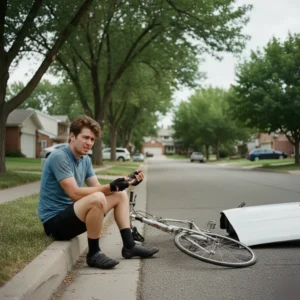
The tactic usually follows a pattern. First, the adjuster requests all medical records related to your head and neck. Then they bring in a biomechanical expert or cite helmet safety data from organizations like the Insurance Institute for Highway Safety. They argue a helmet would have prevented or reduced your head injury. Then they apply a percentage reduction to your claim’s value, and they do it like it’s just math, like it’s settled.
But here’s what they leave out. If you broke your collarbone, fractured your wrist, or tore ligaments in your knee, a helmet wouldn’t have changed any of that. Those are among the most common bicycle accident injuries. The adjuster won’t volunteer that distinction. They lump everything together and hope you accept a lower number without pushing back.
Even for head injuries, the argument isn’t as solid as they make it sound. A standard bicycle helmet is designed for impacts at roughly 12 mph. If a vehicle struck you at 35 mph along Arapahoe Road, the physics don’t support their claim the way they want it to, but they’ll still try.
What This Looks Like in Real Cases
Picture a cyclist riding home from work through the DTC area. A distracted driver drifts into the bike lane near Fiddler’s Green Amphitheatre, that stretch of road gets heavy commuter traffic in the evening, and we’ve seen multiple incidents in that corridor. The cyclist suffers a broken arm, road rash across both legs, and a mild concussion. The driver’s insurance company offers a settlement, but it’s 25% lower than it should be. Their reason? No helmet.
The broken arm is unrelated to a helmet. The road rash is unrelated to a helmet. And the concussion? Helmeted cyclists get concussions in collisions with motor vehicles too. The reduction is manufactured leverage, not a legal requirement.
“Insurance companies know which firms actually take cases to trial, and that affects how your case is handled. A lot of the high-volume firms don’t actually try cases. In fact, many times they end up calling firms like ours to litigate and take their cases to trial.”, Jason Jordan, Founding Partner
When an insurer knows your bicycle accident lawyer has real trial experience, the helmet argument loses its teeth fast. They can’t bully a reduction through if the other side is ready to put the driver’s negligence in front of a jury. That’s not a theory, it’s what we’ve watched happen.
So if an adjuster brings up your helmet, don’t panic. Don’t apologize. And don’t accept a reduced offer without talking to someone who understands how Colorado’s modified comparative negligence law under C.R.S. § 13-21-111 actually applies to bicycle accident claims. The absence of a helmet is not an admission of fault. Not in Colorado. Not under any reading of the law.
Frequently Asked Questions
Does not wearing a helmet mean I can’t get compensation after a bicycle accident in Greenwood Village?
Does not wearing a helmet mean I can’t get compensation after a bicycle accident in Greenwood Village?No — not wearing a helmet does not block your claim. Colorado law does not require adult cyclists to wear helmets, so you haven’t broken any law. Insurance companies will still try to use it against you, but that tactic doesn’t hold up the way they want it to. What matters most is who caused the crash. If a driver ran a red light or cut you off on Arapahoe Road, that’s the fault question. Your helmet choice is a separate issue entirely.
What is comparative negligence, and how does it affect my bicycle accident claim?
What is comparative negligence, and how does it affect my bicycle accident claim?Comparative negligence means fault is split between everyone involved in the crash. Under Colorado law, you can still recover money as long as you’re less than 50% at fault. Insurance adjusters try to push your fault percentage up by pointing to things like a missing helmet. But not wearing a helmet rarely adds much fault — especially for injuries like broken bones or road rash where a helmet wouldn’t have helped at all. Your damages are reduced by your fault percentage, not wiped out.
Will the insurance company use my missing helmet against me during the claims process?
Will the insurance company use my missing helmet against me during the claims process?Yes, and they’ll do it early — sometimes in the very first phone call. Insurance adjusters want you to feel responsible before you’ve spoken to anyone else. They combine the no-helmet issue with anything else they can find to raise your fault percentage. This is one of the most common tactics we see in Greenwood Village bicycle accident cases. Knowing this ahead of time puts you in a much stronger position. Our bicycle accident claims page explains how these cases are handled from start to finish.
Does the no-helmet argument apply to all my injuries, or just head injuries?
Does the no-helmet argument apply to all my injuries, or just head injuries?It only applies — if at all — to head injuries. A helmet wouldn’t have changed a broken collarbone, road rash, or a fractured wrist. Courts look at whether the helmet would have actually prevented each specific injury. For most injuries cyclists suffer, the answer is no. A good lawyer separates your injuries into those a helmet might have affected and those it clearly wouldn’t. That separation protects the full value of your claim.
Are there any Greenwood Village-specific rules or road conditions that affect bicycle accident claims?
Are there any Greenwood Village-specific rules or road conditions that affect bicycle accident claims?Yes. Greenwood Village has busy corridors like Orchard Road, Arapahoe Road, and routes near the Denver Tech Center where cyclists and drivers share the road regularly. Colorado law requires drivers to give cyclists at least three feet of passing space under C.R.S. § 42-4-1003. Intersections along the High Line Canal Trail are common spots for right-of-way disputes. Local road conditions and driver behavior matter when building your case — and none of that changes based on whether you wore a helmet.
Is it a common mistake to assume a bicycle accident claim isn’t worth filing without a helmet?
Is it a common mistake to assume a bicycle accident claim isn’t worth filing without a helmet?Yes — this is one of the biggest misconceptions we see. Many cyclists in Greenwood Village talk themselves out of filing a claim because they weren’t wearing a helmet. They assume they did something wrong and won’t win. That’s exactly what insurance companies want you to think. Not wearing a helmet is not an admission of fault for the crash itself. If someone else caused the collision, you still have a valid claim, and walking away from it means leaving real money on the table.