
Here’s the short version. Colorado runs on a modified comparative negligence system under C.R.S. § 13-21-111. Your claim doesn’t disappear just because you played some role in the crash. But there’s a hard cutoff you need to know about.
Fifty percent. That’s the line.
If a jury finds you 50% or more at fault, you walk away with nothing. Not a reduced check. Zero. If you’re under that threshold, your recovery gets trimmed by your share of fault. So if your damages total $500,000 and you’re found 20% responsible, you collect $400,000. The math is simple. The fight over those percentages is not, and that fight is where truck accident cases are really won or lost.
Why This Matters More in Truck Accident Claims
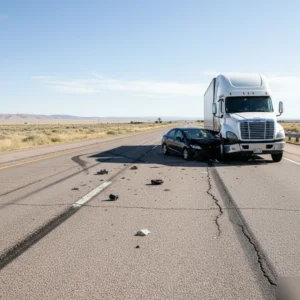
Truck accident claims come with bigger numbers. Catastrophic injuries, extended hospital stays, months of missed work. The trucking company’s insurer knows that a $1 million claim shaved by 15% saves them $150,000. So they work hard on fault percentages. We’ve seen this play out hundreds of times right here in Greenwood Village and across the Denver metro area, and the tactics aren’t subtle.
The adjuster will pull your phone records looking for a text. They’ll get dashcam footage and argue you were following too close on I-25 near the Arapahoe Road interchange. They’ll claim you failed to brake in time or changed lanes without signaling. Every small detail becomes a tool to push your fault number higher, and they start collecting those details before you’ve left the hospital.
How Fault Gets Assigned
Fault doesn’t just split between you and the truck driver. Colorado law spreads it across every responsible party, and commercial truck crashes usually have more than two.
The truck driver may have violated hours-of-service rules and was running fatigued. The trucking company may have pushed a delivery schedule nobody could meet safely. A maintenance contractor may have skipped a brake inspection that was overdue. The cargo crew may have overloaded the trailer, stretching stopping distance beyond what the driver could control. Each of these parties can carry a share of fault under Colorado’s comparative negligence framework, and that actually works in your favor.
The more fault that lands on other parties, the less lands on you. But you need someone who knows how to dig into all of those angles. Insurance companies count on you not knowing this, they want the spotlight on what you did wrong, not on the trucking company’s violations or a maintenance contractor’s shortcuts.
A Real-World Example
Say you’re merging onto I-25 southbound near the DTC and a semi rear-ends you. The trucking company’s insurer argues you merged too slowly. They push for 30% fault on your side. If your damages are $800,000, that argument alone costs you $240,000.
But what if the truck driver’s electronic logging device shows he’d been behind the wheel for 12 hours straight, past the federal limit? What if maintenance records show overdue brake service that nobody flagged? Now the driver and the trucking company absorb more of that fault. Your percentage drops to 5% or 10%. That’s the difference between walking away with $720,000 and walking away with $560,000, from the same crash, with the same injuries.
The percentage game is everything in a truck accident case. And it starts the moment the crash happens. ELD data can be overwritten, dashcam footage gets deleted, witnesses forget what they saw. If you’ve been in a truck accident near Greenwood Village or anywhere along the I-25 corridor, the clock is already running.
Truck Accident Fault Works Differently Than a Standard Car Crash
A two-car collision on Arapahoe Road is relatively contained. Driver A hit Driver B. But a truck accident near the I-25/Orchard Road interchange is a different situation entirely. Multiple parties can share fault, and Colorado’s comparative negligence law under C.R.S. § 13-21-111 applies to every one of them.
Most people don’t realize this going in. You’re not just looking at the driver. You could be looking at the trucking company that hired him, the maintenance shop that skipped a brake inspection, the cargo loader who didn’t secure the freight, or the manufacturer of a defective tire. Each can carry a percentage of fault. That changes the math on your recovery in a real way.
Why Multiple Defendants Matter Under Comparative Negligence
The trucking company’s insurer isn’t just trying to prove their driver was careful. They’re trying to push fault onto you. And onto other defendants when it suits them. We’ve seen this play out in cases up and down the DTC corridor, the defense brings in accident reconstruction experts, pulls phone records, reviews whatever dashcam footage exists. They’ll argue you were following too close, changed lanes without signaling, or were distracted by something on your phone.
Insurance companies count on you not knowing this. They know that shifting even 15% more fault onto you saves them hundreds of thousands of dollars. And they’re counting on you being too overwhelmed to push back.
You’d think the bigger the crash, the more obvious the fault. But that’s actually backwards, bigger crashes mean bigger payouts, which means insurers fight harder on every percentage point.
Federal Regulations Create Extra Layers of Liability

Truck accident cases involve FMCSA regulations that never come up in standard car crash claims. Hours-of-service rules, electronic logging device records, driver qualification files, cargo securement standards, mandatory maintenance logs. Each one creates a potential fault argument against the trucking company or its contractors, and most people injured in these crashes have no idea those records even exist.
Say a delivery truck rear-ends you on Yosemite Street because the driver was in hour 12 of a shift that should have ended at hour 11. That’s a federal hours-of-service violation. It doesn’t just show the driver was negligent. It can show the trucking company was negligent for failing to monitor compliance. Two separate defendants, two separate fault percentages, both working to keep your own number low.
Evidence disappears fast in these cases.
ELD data gets overwritten. Dashcam footage records over itself. Maintenance records go missing. A preservation letter needs to go out to every potential defendant immediately, telling them to save everything. We handle that within hours of taking a truck accident case. Not days. Hours. Because once that data is gone, it’s gone, and no amount of legal argument brings it back.
In a standard car crash, fault usually splits between two drivers. In a truck accident, fault might spread across four or five parties. Colorado’s comparative negligence law applies to all of them. Your attorney needs to understand both FMCSA regulations and Colorado’s fault system to build a case that keeps your percentage as low as possible while stacking fault on the parties who actually caused the wreck. If you’ve been in a truck accident near Greenwood Village, visit our truck accident lawyer page to see how we approach these cases from day one.
For a free legal consultation, call (303) 465-8733
How Fault Percentage Is Actually Determined in Colorado
Most people assume the police officer decides who’s at fault. That’s not how it works. The crash report matters, but it’s one piece of a much larger picture. The actual fault percentage gets decided through negotiation, mediation, or a jury verdict, and insurance adjusters make the first move.
They review the crash report, look at photos, pull the trucker’s ELD data, and then assign a number. Here’s what you need to understand: that number is designed to protect their client. We’ve seen adjusters pin 30% fault on someone who was sitting at a red light in Greenwood Village simply because they “could have reacted sooner.” That’s not an exaggeration. Insurance companies count on you not knowing this.
What Evidence Shapes the Fault Number
If your case goes to litigation, both sides build a fault picture from real evidence. No single item controls the outcome, but some carry more weight than others, and the side that moves faster on evidence usually controls the narrative.
The police report documents what the officer observed at the scene and often includes a contributing factors field. But officers arrive after the crash. They didn’t see it happen. Their report is a starting point, not a conclusion.
Electronic logging devices and dashcam footage from the truck tell a more objective story. ELD data shows whether the driver violated federal hours-of-service rules. Dashcam footage can prove speed, lane position, and distraction. This data gets overwritten fast, a preservation letter needs to go out within days of the crash, sometimes sooner.
Accident reconstruction experts use physics to figure out what actually happened. They calculate speed from skid marks, analyze vehicle damage patterns, review road geometry. Along I-25 near the Arapahoe Road interchange, for example, merge lane distances and grade changes affect stopping time in ways that aren’t obvious without a technical analysis. A good reconstructionist accounts for all of that, and the difference between a thorough one and a mediocre one can swing a fault percentage by 10 points or more.
Witness testimony fills in gaps. Someone sitting at the Fiddler’s Green parking lot exit may have watched the whole thing. Their account can shift a fault determination by double digits.
How Insurance Companies Try to Inflate Your Fault
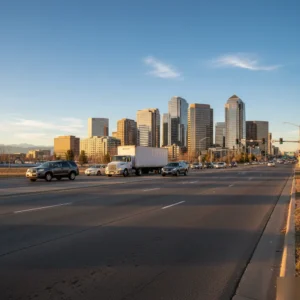
The trucking company’s insurer will look for anything to push your fault percentage higher. Even 1% matters, every point reduces your recovery dollar for dollar under C.R.S. § 13-21-111.
We see the same tactics in truck accident cases around the DTC corridor and Greenwood Village. Failure to brake. They’ll argue you should have stopped sooner, even if the truck ran a light. Speeding allegations. Going 3 mph over the limit on DTC Parkway becomes their excuse to shift blame. Phone records. They’ll subpoena your cell data looking for texts. Even an incoming notification you never opened gets twisted into “distracted driving.”
And here’s what most people miss. The trucking company starts building its defense within hours of the crash. Their investigators go to the scene. They photograph your vehicle. They pull your social media. You’re still in the hospital, they’re already working to raise your fault number.
That’s why timing matters so much. We’ve handled cases where ELD data disappeared because no preservation letter went out in time. Once that data is gone, there’s no recovering it, and the defense knows that.
A jury ultimately decides fault if the case goes to trial. They hear both sides, weigh all the evidence, and assign a percentage to each party. But most of these cases settle before trial. The fault percentage you agree to in settlement is the one that sticks, so you need the evidence to back up your number before you ever sit down at the table.
Frequently Asked Questions
What happens to my truck accident claim if I was partly at fault in Greenwood Village?
You can still recover money as long as you are found less than 50% at fault under Colorado’s modified comparative negligence law. Your payout gets reduced by your share of fault. So if you’re 20% responsible for a crash on I-25 near the Arapahoe Road interchange and your damages are $500,000, you’d collect $400,000. The key is keeping your fault percentage as low as possible. Trucking company insurers work hard to push that number up, starting before you leave the hospital.
Does the 50% fault rule work the same way for truck accidents as it does for car accidents in Colorado?
The same 50% cutoff applies, but truck accident cases are far more complicated. A two-car crash on Arapahoe Road usually involves two drivers. A truck accident near the I-25/Orchard Road interchange can involve the driver, the trucking company, a maintenance contractor, and a cargo crew. Each party can carry a share of fault under C.R.S. § 13-21-111. The more fault that lands on those other parties, the less lands on you, which directly increases what you recover.
Can the trucking company’s insurer use my driving behavior against me in a Greenwood Village crash claim?
Yes, and they start collecting that evidence immediately. Insurers will pull dashcam footage, review phone records, and argue you were following too close or changed lanes without signaling. This is common in crashes along the DTC corridor and on I-25. Every detail they find becomes a tool to raise your fault percentage. Even a 15% shift in fault can cost you hundreds of thousands of dollars on a serious injury claim. That’s why what you do right after the crash matters so much.
What is a common mistake people make about comparative negligence in Colorado truck accident cases?
Many people assume that if a truck hit them, the truck driver is 100% at fault and the case is simple. That’s not how it works. Insurers routinely argue shared fault, even in rear-end crashes. They also focus only on the driver when multiple parties, like a maintenance shop or cargo crew, may actually share responsibility. Missing those other defendants means leaving fault percentages on the table that could have reduced your share. Our Greenwood Village truck accident attorney page explains how these multi-party claims work in more detail.
How do federal trucking regulations affect fault percentages in a Colorado comparative negligence case?
Federal FMCSA rules create extra fault arguments that never come up in standard car crash claims. Hours-of-service logs, electronic logging device records, and mandatory maintenance files can all show the trucking company or its contractors violated federal standards. If a driver was in hour 12 of a shift that should have ended at hour 11, that violation shifts significant fault away from you. Most injured people don’t know these records exist, and they can be overwritten or deleted quickly after a crash.
Does it matter where in Greenwood Village my truck accident happened when it comes to proving fault?
Location can matter more than people expect. Crashes near high-traffic areas like the I-25/Orchard Road interchange or along Yosemite Street often have nearby traffic cameras or business dashcam footage that can support or challenge a fault argument. Witness availability also varies by location. The sooner evidence from those specific spots is preserved, the stronger your position under Colorado’s comparative negligence framework. Waiting even a few days can mean critical footage is gone for good.