


Pedestrians have no metal, airbags, or crumple zones between them and a moving vehicle, and Colorado’s injury and insurance data reflects that: pedestrian crashes produce disproportionately severe injuries compared to almost any other type of traffic collision. That severity is also the biggest single driver of what these claims are worth.
This guide covers what actually goes into a Colorado pedestrian accident settlement, how the state’s right-of-way and comparative fault rules affect a claim, where the money to pay it can come from, and the deadlines that apply — from a firm that has recovered over $550 million for Colorado clients.
What Makes a Pedestrian Accident Claim Different From a Car Accident Claim
Two things separate pedestrian claims from typical vehicle-on-vehicle cases:
Injury severity tends to be higher. Fractures, traumatic brain injury, and spinal cord damage are common even in crashes that would leave two vehicle occupants with minor injuries, which pushes both the medical-expense and noneconomic-damages components of a claim higher than a comparable car accident.
There can be more than one source of recovery. A pedestrian claim isn’t limited to the at-fault driver’s liability policy. Depending on the facts, a claim may also draw on:
- The pedestrian’s own underinsured/uninsured motorist (UM/UIM) coverage, carried through their household auto policy, if the at-fault driver has too little insurance or fled the scene
- A property owner’s or municipality’s liability, when a dangerous crosswalk, missing signal, poor lighting, or defective sidewalk design contributed to the crash
- Multiple defendants, when more than one driver or party shares fault
For a free legal consultation, call (303) 465-8733
What’s Included in a Pedestrian Accident Settlement
Like every Colorado personal injury claim, a pedestrian settlement splits into economic damages (uncapped) and noneconomic damages (capped by statute).
Economic damages (uncapped):
- Emergency care, surgery, hospitalization, and rehabilitation
- Future medical care for catastrophic injuries (TBI, spinal cord injury, amputation)
- Lost wages during recovery and lost future earning capacity
- Out-of-pocket costs — mobility equipment, home modifications, in-home care
Noneconomic damages (capped):
- Pain and suffering
- Loss of enjoyment of life
- Physical impairment and disfigurement — notably, C.R.S. § 13-21-102.5(5) excludes physical impairment or disfigurement from the general damages cap, which matters in pedestrian cases given how often they involve permanent physical impairment
Colorado’s 2026 Damages Caps
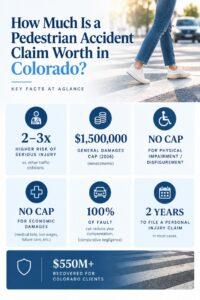
| Damages Category | 2026 Cap |
| General personal injury (noneconomic damages) | $1,500,000 |
| Physical impairment / disfigurement | Not subject to the cap |
| Economic damages (all categories) | No cap |
These caps come from HB24-1472 and apply to civil actions filed on or after January 1, 2025. Biennial inflation adjustments begin January 1, 2028.
Who’s at Fault When a Vehicle Hits a Pedestrian in Colorado
Colorado’s pedestrian right-of-way rules set the starting point for fault, and they cut both ways.
In a crosswalk (C.R.S. § 42-4-802): When signals are absent or not operating, a driver must yield — “slowing down or stopping if need be” — to a pedestrian crossing within a marked or unmarked crosswalk who is on the driver’s half of the road or close enough from the other half to be in danger. A pedestrian, in turn, can’t suddenly leave a curb and walk into the path of a vehicle that’s too close to stop. Passing a vehicle that’s stopped at a crosswalk is also prohibited. Violating this statute is a Class A traffic infraction.
Outside a crosswalk (C.R.S. § 42-4-803): A pedestrian crossing anywhere other than a marked or unmarked crosswalk at an intersection must yield to vehicles on the roadway. Between two intersections where signals are operating, pedestrians are barred from crossing anywhere except a marked crosswalk. Violating this section is a Class B traffic infraction.
None of this automatically decides a claim. A driver can still be found substantially at fault for speeding, distraction, or failing to keep a proper lookout even when a pedestrian wasn’t in a crosswalk — Colorado applies these statutes alongside ordinary negligence principles, not as an automatic bar to recovery.
How Comparative Fault Changes What a Pedestrian Claim Is Worth
Colorado is a modified comparative negligence state under C.R.S. § 13-21-111. If a pedestrian is found partly at fault — for crossing outside a crosswalk, for example — their recovery is reduced by that percentage, and at 50% or more fault they recover nothing.
This is precisely why the crosswalk-versus-jaywalking distinction matters for settlement value even when it doesn’t bar the claim outright: an insurer will use it to argue for a higher fault percentage, and every point of assigned fault comes directly off the top of the settlement.
Click to contact our personal injury lawyers today
Deadlines to File a Pedestrian Accident Claim in Colorado
- Claims against a driver: Three years from the date of the crash, under C.R.S. § 13-80-101(1)(n), which covers tort actions arising from the use or operation of a motor vehicle.
- Claims against a non-vehicle party — a property owner or business whose premises contributed to the crash, for example — generally fall under the two-year general negligence deadline in C.R.S. § 13-80-102.
- Claims against a government entity (a city or county responsible for dangerous intersection design, a missing signal, or inadequate lighting) require written notice within 182 days under the Colorado Governmental Immunity Act — far shorter than either filing deadline above, and it runs independently of them.
Factors That Move a Pedestrian Settlement’s Value Up or Down
- Injury severity and permanency. Traumatic brain injury, spinal cord injury, and multiple fractures push claims well above the noneconomic cap once uncapped economic damages and physical-impairment damages are added in.
- Vehicle speed at impact. Speed is one of the strongest predictors of both injury severity and how a jury or adjuster views driver fault.
- Clarity of right-of-way. A driver who ran a red light and struck a pedestrian in a marked crosswalk presents very differently than a disputed midblock crossing.
- Available insurance, including stacked UM/UIM coverage. A pedestrian’s own auto policy can matter as much as the driver’s liability limits when the at-fault driver is underinsured.
- Comparative fault percentage. Every percentage point assigned to the pedestrian reduces the total recovery directly.
- Documented wage loss and earning capacity, particularly for injuries that end or limit someone’s ability to return to their prior work.
Complete a Free Case Evaluation form now
FAQ
How much is the average pedestrian accident settlement in Colorado?
There’s no reliable average, because pedestrian injury severity varies so widely — from soft-tissue injuries that resolve in weeks to traumatic brain injury or spinal cord damage requiring lifetime care. Because physical impairment and disfigurement damages aren’t subject to Colorado’s noneconomic damages cap, and economic damages are never capped, catastrophic pedestrian cases routinely settle well into seven figures.
Does jaywalking mean I can’t recover compensation in Colorado?
No. Crossing outside a crosswalk can increase the percentage of fault assigned to a pedestrian under Colorado’s comparative negligence rule, but it doesn’t automatically bar recovery. A driver who was speeding, distracted, or otherwise negligent can still bear most of the fault even when the pedestrian wasn’t in a marked crosswalk.
What’s Colorado’s cap on pedestrian accident damages in 2026?
Noneconomic damages (pain and suffering, loss of enjoyment of life) are capped at $1,500,000 for claims filed on or after January 1, 2025. Physical impairment and disfigurement damages are excluded from that cap under C.R.S. § 13-21-102.5(5), and economic damages — medical bills, lost wages, future care — are never capped.
How long do I have to file a pedestrian accident claim in Colorado?
Generally three years from the crash date for claims against a driver, under C.R.S. § 13-80-101(1)(n). Claims against a non-vehicle party may fall under the shorter two-year general negligence deadline, and claims involving a government entity require notice within 182 days under the Colorado Governmental Immunity Act.
Can I still recover if I was partly at fault for the accident?
Yes, as long as you’re found less than 50% at fault. Colorado’s modified comparative negligence rule, C.R.S. § 13-21-111, reduces your recovery by your percentage of fault rather than eliminating it — except at 50% or more, where the claim recovers nothing.
Conclusion
Pedestrian accident claims in Colorado carry higher stakes than most vehicle collisions, both because the injuries tend to be more severe and because more than one insurance policy or defendant can be in play. Right-of-way rules and comparative fault will shape the case, but they rarely decide it outright.
If you or a loved one has been hit by a vehicle, Jordan Law Accident & Injury Lawyers offers free, no-obligation consultations and has recovered more than $550 million for Colorado clients. There’s no fee unless we win.