
Colorado’s hands-free driving law, SB 24-065, took effect in 2024. It changed the rules for every driver in Denver, Aurora, Greenwood Village and across the state. But most people we talk to don’t actually know what the law says. They think it’s about texting. It’s not.
The law makes it illegal to hold your phone while driving. Full stop.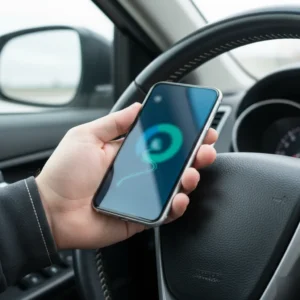
That means you can’t pick up your phone to check a notification at a red light on Arapahoe Road. You can’t hold it to your ear while merging onto I-25 from Orchard Road. You can’t cradle it between your shoulder and chin on a call through DTC. If your hand is on the phone and you’re behind the wheel, you’re breaking the law. The phone needs to be mounted, sitting in a cupholder, or connected through Bluetooth, and that’s about as far as the exceptions go.
What Counts as a Violation
Holding a phone for any reason is prohibited. Calls, maps, music, doesn’t matter. Gripping it is the violation. We’ve seen cases where drivers were recording something on their phone right before a crash. That’s now a clear statutory violation under SB 24-065, and it matters a lot for your accident claim.
Manual data entry, typing an address into GPS, composing a text, entering a number by hand, is off the table unless the vehicle is lawfully parked. Same goes for swiping or scrolling. Checking social media, reading emails, browsing anything on a screen you’re holding. The law treats it the same as texting while driving.
Voice commands are still fine. You can tap a mounted phone once to accept or end a call. Emergency calls to 911 are allowed. First responders on duty have limited exemptions. That’s the list.
The Exceptions Are Narrow
So why does this matter for your accident claim? A hands-free violation is real evidence of negligence. If the other driver was holding their phone when they hit you, they broke a Colorado statute, and that’s not just a traffic ticket. It’s a fact your attorney can use to establish fault.
Adjusters will try to minimize it. We’ve heard things like “well, they were just glancing at their phone” as if that changes anything. Under SB 24-065, it doesn’t. Holding the phone is the violation. The crash is the result. Those two things together are what your claim is built on.
And here’s something most people don’t catch until it’s too late, phone records don’t always tell the full story. The law covers holding the device, not just active use. So even if the other driver’s call log looks clean, they could still have been in violation. That’s where a distracted driving attorney who actually knows this statute can dig into the evidence in ways a general practitioner won’t think to.
If you were hit by someone holding their phone anywhere near Greenwood Village, that violation gives your claim real weight. It shifts the conversation from “who was more at fault” to “the other driver broke the law.” Those are very different conversations to have with an insurance company.
How a Hands-Free Violation Affects Fault in Your Accident Claim
Here’s where SB 24-065 gets real for your claim. If the other driver was holding their phone when they hit you, that violation is powerful evidence of negligence, not just “they were being careless” evidence. Statutory evidence. The kind that’s hard to argue against.
Colorado follows a rule called negligence per se. Legal term, simple idea: when someone breaks a safety law and that violation causes an injury, the law treats the violation itself as proof of negligence. The other driver doesn’t get to say “I was being careful even though I was on my phone.” They broke SB 24-065. They caused a crash. That’s negligence.
What This Means at the Insurance Level
 Most drivers don’t realize how much a documented hands-free violation shifts the fault conversation. We’ve seen adjusters try to treat it like a minor detail. It’s not. A statutory violation under SB 24-065 puts the other driver on the wrong side of the law before anyone even gets to questions about speed or lane position or braking distance.
But the other driver’s insurance company won’t just concede the point. They’ll look for ways to split fault onto you. Colorado’s modified comparative negligence rule under C.R.S. § 13-21-111 means your recovery gets reduced by your percentage of fault, and if you’re found 50% or more at fault, you recover nothing. Zero.
So even when the other driver was clearly on their phone, expect the insurer to argue you were speeding on Arapahoe Road. Or that you failed to brake in time near the I-25 interchange. Or that you weren’t wearing a seatbelt. They’ll throw everything they can at the wall to push your fault percentage up. Insurance companies count on you not knowing this, and not having an attorney who does.
How Phone Records Become Your Evidence
The strongest hands-free violation cases we handle have one thing in common. Good evidence, preserved early.
Think about what actually proves someone was using their phone. The police report might note it. Witnesses at the scene might have seen the phone in the driver’s hand. But the real proof lives in the cell carrier data, screen time, app usage, timestamps at the moment of impact. That data can disappear or become harder to get if you wait.
We’ve seen this play out many times in Greenwood Village and across the Denver Tech Center corridor. A client comes to us weeks after a crash on Yosemite Street or near Fiddler’s Green. They know the other driver was on their phone. But nobody preserved the evidence right away, the police report is vague, and now it’s the client’s word against the other driver’s denial. That’s a harder case than it had to be.
A distracted driving attorney can send a preservation letter to the other driver’s cell carrier and insurance company. This locks down the evidence before it gets deleted or overwritten. The window for doing that is shorter than most people think.
One more thing people miss, the hands-free violation doesn’t just help prove fault. It can support a claim for higher damages. A jury in Arapahoe County sees that someone was scrolling their phone on DTC Boulevard and slammed into you at 45 mph, that changes how they feel about the case. Juries don’t like drivers who break safety laws, and that weight translates into real numbers at trial.
You have three years to file a motor vehicle accident claim under C.R.S. § 13-80-101. But the evidence that makes a hands-free case strong won’t wait three years. If you were hit by a distracted driver in Greenwood Village, getting an attorney involved now, while the proof still exists, is the move that makes the difference later.
For a free legal consultation, call (303) 465-8733
Proving the Other Driver Was on Their Phone After a Colorado Crash
This is where most accident claims get real. You know the other driver was on their phone. Maybe you saw them looking down right before impact. But knowing it and proving it are two different things, and that gap is exactly where claims fall apart when evidence isn’t preserved fast.
Under SB 24-065, holding a phone while driving is illegal in Colorado. Clear rule. So if the other driver broke it, that’s negligence per se, they broke a safety law designed to prevent crashes, and a crash happened. Connect the dots.
But you still need evidence. And evidence disappears fast.
Phone Records and Subpoenas
Cell carriers keep records of calls, texts, and data usage with timestamps. Your attorney can subpoena those records. If the other driver sent a text at 4:47 PM and the crash happened at 4:47 PM, that’s powerful. But carriers don’t hold all data forever, some purge records within months. We’ve seen cases where waiting too long meant the records were simply gone.
App data matters too. Scrolling social media or watching a video leaves a trail. Getting access to it requires legal action, so the sooner you involve an attorney, the better your chances of actually preserving that data.
 Crash Scene Evidence
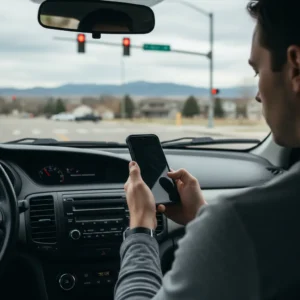
Think about what’s available right at the scene. Dashcam footage from your car or a nearby vehicle can show the other driver’s head position in the seconds before impact. Traffic cameras along corridors like Arapahoe Road or near the I-25 interchange sometimes capture exactly what you need. Witness statements help too, did someone in the next lane see the driver looking at their lap?
We’ve handled cases where a single witness statement turned everything around. One person said “I saw them holding their phone” and suddenly the insurance company’s lowball offer tripled. (That kind of thing doesn’t make the evening news, but it happens more than people think.)
The Phone Itself
The other driver’s phone is a goldmine of evidence. Screen time logs, notification history, app usage data, all of it can show exactly what was happening at the time of the crash. But nobody’s going to hand over their phone voluntarily. Your attorney needs to send a preservation letter fast. That letter tells the other side: don’t delete anything, don’t factory reset, don’t “lose” the device.
Without that letter, evidence vanishes. People panic after a crash. Texts get deleted, browsing history gets cleared,
What Insurance Companies Do With This
Even when you have solid proof the other driver was on their phone, the insurance company will try to flip it. Colorado’s modified comparative negligence rule under C.R.S. § 13-21-111 gives them room to argue you were partly at fault too. Maybe you were going five over the speed limit on Orchard Road. Maybe you didn’t brake fast enough. If they can push your fault to 50% or higher, you recover nothing.
So proving phone use isn’t just about the other driver. It’s about building a case so strong that the comparative negligence argument falls flat. The hands-free violation becomes your anchor. Everything else supports it.
If you were hit by a distracted driver in Greenwood Village or anywhere nearby, the evidence clock starts running from the moment of impact. Our distracted driving attorneys at Jordan Law know exactly what to request and when. Don’t let the proof disappear while you’re still dealing with your injuries. Call us anytime, we’re available 24/7 and consultations are always free.
Frequently Asked Questions
Does a hands-free violation automatically mean the other driver is at fault for my accident?
A hands-free violation is strong evidence of fault, but it doesn’t guarantee a 100% fault ruling on its own. Colorado uses modified comparative negligence under C.R.S. § 13-21-111. That means both drivers can share fault. The other driver’s insurer will still look for ways to push some blame onto you — even when they clearly broke SB 24-065. The violation gives your claim real weight, but building the full picture of what happened still matters.
What is negligence per se, and how does it apply to my Greenwood Village accident claim?
Negligence per se means that breaking a safety law is treated as proof of negligence in court. If the driver who hit you was holding their phone in violation of SB 24-065, they don’t get to argue they were still being careful. The violation itself establishes negligence. For accidents near Arapahoe Road, the I-25 interchange, or anywhere else in Greenwood Village, this legal rule can shift the fault conversation in your favor from the start.
What’s a common mistake people make after a distracted driving crash in Greenwood Village?
The biggest mistake is waiting too long to preserve phone evidence. Cell carrier data — screen time, app usage, timestamps — can disappear quickly. Many people come in weeks after a crash on Yosemite Street or near Fiddler’s Green knowing the other driver was on their phone, but nobody locked down the evidence early. A distracted driving attorney can send a preservation letter right away to protect that data before it’s gone.
Can the other driver avoid blame if their call log looks clean at the time of the crash?
No — a clean call log doesn’t clear them. SB 24-065 makes it illegal to hold the phone, not just to make calls. The driver could have been scrolling, checking a map, or recording something without making a single call. Phone records alone don’t tell the full story. That’s why a distracted driving attorney looks beyond call logs into broader device data and app activity to build your case. Learn more on the parent page about distracted driving accident claims.
Does Colorado’s hands-free law apply when a driver is stopped at a red light?
Yes, it does. SB 24-065 applies any time you are behind the wheel, including at red lights. Picking up your phone to check a notification at a stoplight on Arapahoe Road is still a violation. The law only allows phone use when the vehicle is lawfully parked. This matters for your claim because it closes the loophole drivers often try to use when they say they “weren’t moving” at the time of the incident.
How does Colorado’s modified comparative fault rule affect my recovery if I was partly at fault near the DTC?
Under Colorado’s modified comparative negligence rule, your compensation is reduced by your percentage of fault. If you are found 50% or more at fault, you recover nothing. Insurance companies know this. Even when the other driver was clearly holding their phone near the Denver Tech Center corridor, adjusters will argue you were speeding or failed to brake in time. Knowing this rule ahead of time helps you understand why documenting everything at the scene matters so much.