
Most people have never been in a serious crash before. So when it happens on Arapahoe Road or near the I-25 interchange, your brain goes blank. That’s normal. But the next 15 to 20 minutes shape everything that follows, your medical claim, your insurance fight, your ability to prove what actually happened.
We’ve seen this play out hundreds of times at our office right here on DTC Parkway. Someone does all the right things at the scene, and their case is solid from day one. Someone else drives home shaken, skips the ER, doesn’t take a single photo. Six months later they’re fighting an adjuster who says the crash “wasn’t that bad.”
Here’s what to do, in order.
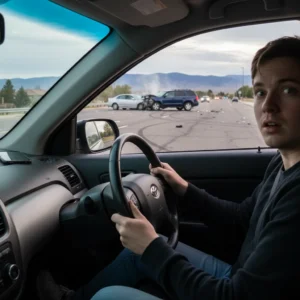
Stop your vehicle and check for injuries. Colorado law requires you to stop after any crash. Pull to a safe spot if you can. Check yourself first, then your passengers. Adrenaline masks pain. You might feel fine and still have a concussion or soft tissue damage that shows up hours later, we see that constantly.
Call 911. Even for a minor fender bender near the Landmark or along Orchard Road, get Greenwood Village police on scene. An official police report is one of the strongest pieces of evidence you’ll have. Without it, the other driver’s story can shift completely once their insurance gets involved.
Move to safety if you can. The DTC corridor carries heavy traffic during rush hour. If your car is drivable, pull into a parking lot or side street. Staying in a live lane on Yosemite Street or Belleview Avenue puts you at real risk of a secondary crash.
Document everything with your phone. Take wide shots and close-ups. Photograph damage to both vehicles, skid marks, traffic signals, road conditions, license plates. Get the other driver’s insurance card on camera. Screenshot the time and location. Three minutes of photos is worth more than you realize right now.
Exchange information, but don’t discuss fault. Get their name, phone number, insurance info, and driver’s license number. That’s it. Don’t apologize. Don’t say “I didn’t see you.” Adjusters will use your own words against you later, and they’re very good at it.
Talk to witnesses before they leave. If someone saw the crash, get their name and number. Witnesses disappear fast. A bystander who saw the other driver run a red light near Fiddler’s Green could be the difference in your case.
Get medical attention the same day. Sky Ridge Medical Center is close. Tell them you were in a crash and describe every symptom, even a headache or stiff neck. That medical record ties your injuries directly to the collision. Adjusters look for gaps in treatment, and they will argue you weren’t seriously hurt if you waited a week to see anyone.
Here’s something most crash victims don’t know. Under Colorado’s modified comparative negligence rule (C.R.S. § 13-21-111), the other side only needs to prove you were 50% or more at fault to wipe out your claim entirely. Solid scene evidence protects you from that argument before it even gets raised.
If you’ve already been in a crash on Greenwood Village roads and you’re not sure what to do next, our car accident lawyers can walk you through it. The consultation is free, and you pay nothing unless we recover for you.
Collecting Evidence at the Crash Scene Protects Your Claim
Your phone is the most useful tool you have after a crash. Use it. We’ve seen cases where a single photo taken at the scene made the difference between a strong claim and one that fell apart. Evidence disappears fast on Greenwood Village roads, and most people don’t figure that out until it’s already gone.
Skid marks fade within hours. Glass gets swept up. The other driver’s account can change completely between the scene and the recorded statement they give their adjuster two weeks later.
Here’s what to document if you’re physically able.
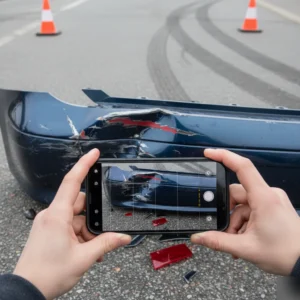
Photograph everything around you. Start wide. Get shots of the full intersection or stretch of road. Along Arapahoe Road near the I-25 interchange, the lane markings and signal positions matter, capture both. Get both vehicles from multiple angles. Close-ups of damage, debris, and any visible injuries on your body. The other driver’s license plate, insurance card, driver’s license. All of it.
Record the scene conditions. Was the pavement wet? Was the sun in someone’s eyes heading westbound on Orchard Road around 4:30 p.m.? (That westbound glare in the late afternoon is genuinely bad out there, we hear about it often.) Were there construction cones narrowing lanes near the DTC office complexes? These details feel obvious right now. You won’t remember them in three months when the adjuster asks.
Get witness information before they walk away. Bystanders leave. Other drivers pull off and keep going. If someone saw what happened, ask for their name and phone number. A witness who confirms the other driver ran a red at Yosemite and Belleview is worth more than almost anything else you can collect at the scene.
Write down your own account while it’s fresh. Open your phone’s notes app and type exactly what happened, where you were going, what lane you were in, what you saw right before impact. This becomes your anchor when memories start to blur, and they will blur.
Don’t skip the police report. Call the Greenwood Village Police Department. Under Colorado law, crashes involving injury or property damage over $1,000 should be reported. The responding officer’s report isn’t the final word on fault, but it creates an official record and captures the other driver’s statements at the scene. Those statements are hard to walk back later.
One thing we see all the time: clients come in with almost no documentation from the scene. They were shaken up. They trusted the other driver who seemed apologetic. Then that driver’s insurance company denies the claim or argues comparative negligence under C.R.S. § 13-21-111, saying you failed to brake, that you were on your phone, that you contributed to the crash. Without evidence, it becomes your word against theirs.
But when you walk in with 40 photos, a witness name, and a written account from the scene? That changes everything about how we build your case.
If you didn’t collect much evidence, don’t panic. Surveillance cameras from nearby businesses along the Arapahoe Road corridor, traffic camera footage, and electronic data from your vehicle can sometimes fill the gaps. A car accident lawyer can send preservation letters to make sure that footage doesn’t get deleted before anyone reviews it.
For a free legal consultation, call (303) 465-8733
What Not to Say After a Crash in Colorado
The words you use at the scene matter more than most people expect. Every statement you make, to the other driver, to a witness, to a police officer, can be pulled into your claim later. And it can be twisted.
We’ve seen this play out hundreds of times. Someone says “I’m sorry” because they’re a decent person. That’s it, just being polite. But three months later, an insurance adjuster uses that apology as an admission of fault. Colorado follows modified comparative negligence under C.R.S. § 13-21-111, meaning if they pin 50% or more of the blame on you, your recovery drops to zero. One offhand comment can shift that percentage.
Phrases That Hurt Your Case
“I’m sorry” is the big one. It feels natural, you’re shaken up, the other person looks upset, you want to be decent. Adjusters treat it like a confession. Don’t say it.
“I’m fine” is almost as damaging. Adrenaline masks pain. You might feel okay standing on Arapahoe Road five minutes after a collision, then wake up the next morning unable to turn your neck. If a police report or witness statement says you told everyone you were fine, the insurance company will argue your injuries aren’t from the crash.
“I didn’t see you” hands them a negligence argument. Same with “I wasn’t paying attention” or “I was looking at my phone.” Under Colorado’s hands-free driving law, SB 24-065, phone use while driving is already a violation. Admitting it at the scene locks that in permanently.
“It was my fault” should never leave your mouth. You don’t have all the facts yet. Maybe the other driver ran a red. Maybe a traffic signal near the DTC Parkway corridor was malfunctioning. You can’t know everything in those first few minutes, so don’t guess out loud.
What to Say Instead
Keep it simple. “Are you okay?” is fine. “I need to call 911” is fine. When the officer arrives, give factual answers, where you were going, what street you were on, what direction you were traveling. Stick to what you’re sure about.
If the other driver or a witness asks what happened, you can say “I’d rather not discuss it right now.” That’s not rude. That’s protecting yourself from saying something inaccurate while your brain is still processing what just happened.
Here’s a real scenario we see in Greenwood Village. Two cars collide near the I-25 and Orchard Road interchange during rush hour. Both drivers get out. One says “I think I might have been going too fast.” The other says nothing beyond basic facts. Guess which driver’s insurance company has an easier time denying the claim?
And don’t forget the phone call that comes a day or two later. An adjuster from the other driver’s insurance will reach out. They’ll sound friendly, they’ll ask for a recorded statement. You don’t have to give one. In fact, you shouldn’t, not without talking to a professional car accident lawyer first.
“I have people tell me all the time, ‘I’ve been dealing with this insurance company for 20 years and they’ve always treated me great.’ And I say, ‘Have you ever made a claim?’ and they say, ‘no.’ Well, ok, so the person who has been taking your money has been treating you great. Not surprising. Wait till you go to the claims department.”, Jason Jordan, Founding Partner, Jordan Law Accident & Injury Lawyers
If you’ve already said something you’re worried about, that doesn’t mean your case is over. But it does mean you should talk to someone who handles these situations every day. You can reach our team at Jordan Law Accident & Injury Lawyers to figure out where things stand.
Frequently Asked Questions
Do I have to call the police after a crash on Greenwood Village roads, even if it seems minor?
Yes, you should call the police even for a minor crash in Greenwood Village. Colorado law requires reporting crashes that involve injury or property damage over $1,000. The Greenwood Village Police Department will create an official report. That report locks in the other driver’s statements at the scene. Without it, their story can shift completely once their insurance company gets involved. A police report is one of the strongest pieces of evidence you’ll have.
What information should I collect from the other driver at the scene?
Get their name, phone number, driver’s license number, and insurance card. Photograph all of it with your phone. That’s the information you need. Do not discuss who was at fault. Do not apologize. Do not say anything like “I didn’t see you.” Adjusters are trained to use your own words against you later. Keep the exchange short and factual. Three minutes of photos at the scene is worth more than you might realize right now.
Is it a mistake to skip the ER if I feel okay after a crash near the DTC or along Arapahoe Road?
Skipping medical care the same day is one of the most common mistakes crash victims make. Adrenaline masks pain. You can have a concussion or soft tissue damage and feel fine for hours. Sky Ridge Medical Center is close to the Greenwood Village area. Go the same day and tell them you were in a crash. That medical record directly connects your injuries to the collision. Insurance adjusters look for gaps in treatment and will argue you weren’t seriously hurt if you waited.
How does Colorado’s fault rule affect my crash claim if I made a mistake at the scene?
Colorado uses a modified comparative negligence rule under C.R.S. § 13-21-111. If the other side proves you were 50% or more at fault, you lose your entire claim. Strong scene evidence — photos, a police report, witness contact information — protects you from that argument before it even gets raised. If you’re unsure what your scene documentation means for your case, a car accident attorney can review it with you. Learn more on our car accident lawyer page.
Why do skid marks and road conditions matter after a crash on roads like Orchard Road or Yosemite Street?
Skid marks, lane markings, signal positions, and road conditions help prove what actually happened. Westbound glare on Orchard Road in late afternoon is a real hazard. Wet pavement changes stopping distance. Construction zones near the DTC office corridors narrow lanes. These details feel obvious at the scene but fade fast — skid marks can disappear within hours. Photograph everything around you before you leave. You won’t remember these details three months later when an adjuster starts asking questions.
What’s the biggest misconception people have about crash scenes in Greenwood Village?
The biggest misconception is that if the other driver seems apologetic, you don’t need to document anything. People trust that the other driver will tell the truth to their insurance company. That trust is often misplaced. Once their adjuster gets involved, accounts change. The other driver may claim you failed to brake or that the damage was minor. Your photos, your police report, and your witness contacts are what protect you when that happens — not a handshake at the scene.