
If you’re asking what should I do right after a truck accident near the I-25 and Orchard Road interchange, you’re already thinking the right way. That interchange sees heavy semi traffic all day, trucks merging across lanes toward the Denver Tech Center, commuters cutting in late on the on-ramp, and big rigs that simply cannot slow down the way a passenger car can. We’ve handled cases from that exact stretch. Some clients did everything right in the first hour. Others made small mistakes that cost them real money later.
The first few minutes set the tone for everything that follows.
Your body is running on adrenaline right now. You might feel fine. That does not mean you are fine. Truck accidents involve forces that passenger vehicles aren’t built to absorb, and soft tissue injuries or mild traumatic brain injuries can take hours, sometimes days, to show up. Don’t wave off the paramedics. Let them check you out on scene. If they recommend transport, go. Sky Ridge Medical Center is close to that interchange. Swedish Medical Center in Englewood is another option. Get seen. Get it documented. The record you create in those first hours becomes part of your case file.
What to Do While Still at the Scene
Call 911 immediately. Colorado law requires a police report when there’s injury or real property damage, and truck accidents almost always qualify. The responding officer will document the truck’s license plate, the carrier name on the door, and the driver’s CDL information. You need that report. Without it, you’re starting from behind, and insurance companies count on you not knowing that.
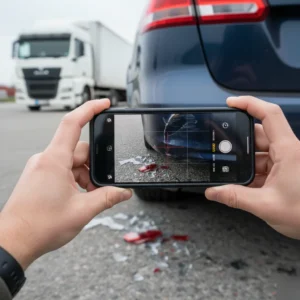
While you wait for police, use your phone. Photograph everything, the truck’s DOT number on the cab, skid marks on the pavement, damage to your car from every angle, the position of both vehicles before anything gets moved, and the traffic signs near the Orchard Road ramp. Take wide shots showing the interchange layout. That context matters when someone has to reconstruct what happened six months from now in a conference room.
If there are witnesses, get their names and numbers. The people at that interchange are often DTC commuters heading to offices along Greenwood Plaza Boulevard or Fiddler’s Green Circle, they saw what happened, but they won’t stick around, and they won’t remember details three months from now.
What Not to Do
Don’t talk to the trucking company’s insurance adjuster. They will call fast, sometimes within hours of the crash. They’re trained to get you on a recorded line and ask questions designed to shrink your claim. “You’re feeling okay though, right?” is not a friendly question. It’s a setup.
Don’t post about the accident on social media. Don’t apologize to the other driver. Don’t say “I’m fine” to anyone with a clipboard. Under Colorado’s modified comparative negligence rule (C.R.S. § 13-21-111), the trucking company’s legal team will use anything you say to argue you were partly at fault. Push your share of fault to 50% or higher, and you recover nothing. Zero.
We’ve seen this play out more times than we can count. Someone does everything right at the hospital, then gives a casual statement at the scene that gets twisted six months later in a deposition. The scene is not the place to explain what happened. That comes later, with a truck accident lawyer beside you.
If you’ve already been through this and you’re not sure whether you handled it right, that’s okay. Most people don’t get a rehearsal for something like this. But talking to a truck accident lawyer now can protect what matters going forward. You can learn more about how Jordan Law handles these cases on our truck accident page.
How to Document the Scene If You Are Able to Do So Safely
Your phone is the most powerful tool you have right now. But only if you use it before the scene changes, and it changes fast.
We’ve handled cases at this interchange where critical evidence was gone within hours. Skid marks get worn away by traffic. Debris gets swept up by CDOT crews. The trucking company sends its own response team to the scene quickly, sometimes before you’ve left the hospital. What you capture in those first minutes can shape your entire case.
What to Photograph First
If you can move around safely, start wide. Stand back and take shots showing both vehicles, the road layout, and the interchange ramps. Then move in close. Get the truck’s license plate, the DOT number on the cab door, and the company name on the trailer. That DOT number is how we trace the carrier’s safety record through federal databases, without it, identifying the right parties gets harder and takes longer.
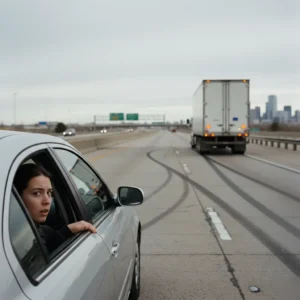
Photograph your vehicle’s damage from every angle. Get the truck’s damage too. And here’s something most people skip: photograph the road surface itself. Tire marks, gouges in the pavement, fluid spills. Those details tell the story of what happened before impact, not just after.
Details That Matter More Than You Think
Traffic signals and lane markings near the interchange matter. The I-25 and Orchard Road area has merge lanes, exit ramps, and construction zones that shift around, a photo of a faded lane marker or an obscured sign could become a key piece of evidence if road design played a role. (CDOT has jurisdiction over I-25 itself, and claims against government entities like CDOT require a 182-day notice under C.R.S. § 24-10-109, another reason early documentation matters.)
Snap the weather conditions. Grab a screenshot showing the time and date on your phone. If witnesses are nearby, ask for their contact information or photograph their license plates. Witnesses leave and don’t come back. We’ve handled cases where the only independent witness drove off before anyone got a name, and that’s evidence you simply cannot recover.
Video Captures What Photos Miss
A slow 360-degree video from where your car ended up is worth more than 50 still photos. It captures spatial relationships, how far the truck traveled after impact, the angle of the vehicles, the road conditions in every direction. It also picks up sounds, other drivers’ comments, and sometimes the truck driver’s own statements at the scene. Those spontaneous statements can carry real weight later.
Walk the video from your vehicle toward the truck if you can do it without stepping into live traffic on I-25. Narrate what you see. “This is where my car stopped. The truck is about 40 feet ahead.” Simple descriptions help us reconstruct the scene weeks or months later when memories have faded and everyone’s telling a different story.
Your Own Injuries
Photograph your injuries. Bruises, cuts, swelling, document it on scene. Insurance adjusters love to argue that injuries weren’t that serious, and a photo taken at the scene showing blood on your shirt or a visibly swollen wrist tells a different story than medical records alone.
Don’t delete anything. Not the blurry shots. Not the ones with bad lighting. Our team at Jordan Law can work with imperfect photos, we’ve pulled useful details from images clients almost threw away.
If your injuries prevent you from documenting anything, ask a passenger or bystander to help. A few photos beat none. The goal isn’t a perfect photo set. The goal is preservation. If you’d like to understand how this evidence fits into a truck accident claim, our truck accident lawyer page walks through the full process.
For a free legal consultation, call (303) 465-8733
Truck Accidents Are Legally Different From Regular Car Crashes

Most people assume a collision at the I-25 and Orchard Road interchange works the same as any other car crash. It doesn’t. Not even close. The legal rules are different, the number of responsible parties is different, and the evidence you need disappears faster than you’d expect.
A regular car crash usually involves two drivers and two insurance policies. A truck accident can involve the driver, the trucking company, the company that loaded the cargo, the maintenance shop, and sometimes the truck manufacturer. Each one of those parties has their own insurance carrier and their own legal team, and every single one of them will try to shift blame to someone else.
We’ve seen this play out on the I-25 corridor through Greenwood Village and the Denver Tech Center. A semi loses control near the Orchard Road interchange, and within hours the trucking company has already sent an accident response team to the scene. They’re not there to help you.
Federal Regulations Add Layers That Don’t Exist in Car Cases
Truck drivers and trucking companies must follow rules set by the Federal Motor Carrier Safety Administration. These FMCSA regulations cover hours-of-service limits, electronic logging device requirements, driver qualification files, cargo securement standards, and vehicle maintenance schedules. A regular driver has none of these obligations. A violation of any FMCSA rule can be strong evidence of negligence, the kind of negligence that changes the value of a case.
A driver who exceeded their hours-of-service limit and fell asleep near Orchard Road didn’t just make a mistake. They broke federal law. That’s a different kind of case than two commuters bumping mirrors in a parking lot off Yosemite Street.
Evidence Disappears Fast in Truck Cases
Electronic logging devices record driving hours, but that data can be overwritten. Dashcam footage from the cab gets recorded over in cycles. GPS data showing the truck’s speed and route has retention limits. If nobody sends a preservation letter to the trucking company quickly, that evidence is gone, no way to recover it.
Insurance companies count on you not knowing this. They know that if you wait three or four weeks to call a truck accident lawyer, the ELD data might already be wiped. The driver’s post-accident drug and alcohol test results might be harder to obtain. Witness memories fade. Skid marks on the road near the interchange get driven over and worn away.
Colorado’s statute of limitations for motor vehicle accidents is three years under C.R.S. § 13-80-101, but the practical deadline for preserving truck-specific evidence is measured in days, not years. That gap is where cases get lost.
“Insurance companies know which firms actually take cases to trial, and that affects how your case is handled. A lot of the high-volume firms don’t actually try cases. In fact, many times they end up calling firms like ours to litigate and take their cases to trial.”, Jason Jordan, Founding Partner
Colorado follows modified comparative negligence under C.R.S. § 13-21-111. The trucking company’s lawyers will argue you were partly at fault, maybe you changed lanes too quickly, maybe you were following too close. Push your fault to 50% or higher, and you recover nothing. Building a strong evidence file early is what keeps that argument from gaining traction.
If you’ve been in a crash at the I-25 and Orchard Road area, the smartest move is talking to a truck accident lawyer before the other side finishes building their defense. Because they started the moment the crash happened.
Frequently Asked Questions
Should I move my vehicle after a truck accident at the I-25 and Orchard Road interchange?
Only move your vehicle if it is creating an immediate safety hazard, like blocking active lanes on I-25. If you can stay put safely, leave everything where it is until police arrive. The position of your car relative to the truck tells a story. Moving vehicles too soon destroys that story. Use your phone to photograph the scene from multiple angles before anything shifts. That documentation protects you later.
Why do trucking companies send their own team to the scene so fast?
Trucking companies send a rapid response team because they want to control the evidence early. Their team may photograph the scene, interview witnesses, and preserve data from the truck’s black box — all before you’ve left the hospital. This is standard practice, not a coincidence. That’s why your own documentation in the first few minutes matters so much. What you capture before that team arrives can be the difference in your case.
What is the DOT number on a truck, and why does it matter after a crash near Greenwood Village?
The DOT number is a federal ID assigned to commercial carriers. It appears on the cab door of most semi-trucks. After a crash near the I-25 and Orchard Road interchange, that number is how attorneys trace the carrier’s full safety record through federal databases. It also helps identify the right company to name in a claim. Without it, tracking down the carrier takes longer and gets harder. Photograph it before the truck moves.
What is Colorado’s modified comparative negligence rule, and how does it affect my truck accident claim?
Under Colorado’s modified comparative negligence rule (C.R.S. § 13-21-111), you can only recover damages if your share of fault is below 50%. If the trucking company’s legal team pushes your fault to 50% or higher, you recover nothing. This is why what you say at the scene matters. Casual comments like “I’m fine” or an apology can be used later to argue you were partly responsible. Say as little as possible until you have legal guidance.
Do I really need to see a doctor if I feel okay right after the crash?
Yes — get checked out even if you feel fine. Soft tissue injuries and mild traumatic brain injuries often don’t show up for hours or even days after a crash. Adrenaline masks pain. Truck accidents involve forces that passenger vehicles aren’t built to handle. Sky Ridge Medical Center is close to the I-25 and Orchard Road interchange. If paramedics recommend transport, go. The medical record you create that day becomes part of your case file and supports your claim later.
What is a 182-day notice, and does it apply to crashes on I-25 near Greenwood Village?
If road design or maintenance played a role in your crash — like a faded lane marker or an obscured sign near the Orchard Road ramp — CDOT may share responsibility. Claims against government entities like CDOT require a 182-day notice under C.R.S. § 24-10-109. Miss that window and you lose the right to pursue that part of your claim entirely. This is one reason early documentation and legal guidance matter. You can learn more about how these cases are handled on the truck accident page.