
A regular car accident usually has two drivers and two insurance policies. That’s it. A delivery truck accident in Greenwood Village is something else entirely, suddenly you’re dealing with a driver, a delivery company, maybe a vehicle owner who’s separate from both, a cargo loading crew, and a maintenance contractor. We’ve seen cases here where five or six different parties all pointed fingers at each other while an injured client waited for answers.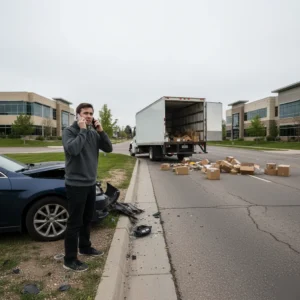
That sounds like chaos. It is, unless you know how to use it.
Here’s why multiple liable parties actually matter to your case. Each one may carry its own insurance policy. The driver might have a personal auto policy. The delivery company carries a commercial policy. The vehicle leasing company has another. A third-party maintenance shop could have a general liability policy. More policies mean more potential sources of recovery for your injuries. Insurance companies count on you not knowing this, they want you to file against one party, settle fast, and move on.
We’ve seen this play out hundreds of times.
Who Can Be Liable in a Delivery Truck Accident
The driver is the obvious starting point. Were they speeding down Yosemite Street trying to hit a delivery window? Were they on their phone in violation of Colorado’s hands-free law under SB 24-065? The driver’s own negligence is always in play, and it’s usually where we start building the picture.
The delivery company often bears responsibility through a legal concept called vicarious liability. If the driver was on the clock making deliveries, the company that dispatched them typically shares the blame. This applies to Amazon, FedEx, UPS, and smaller regional carriers running routes along the I-25 corridor near the DTC, the ones you see stacked up at the Orchard Road exits during the holiday crunch.
The vehicle owner might be a separate entity entirely. Many delivery operations use leased vehicles. The leasing company has a duty to keep those trucks in safe condition. If they skipped brake inspections or ignored a recall, they’re on the hook too.
Maintenance contractors create another layer. Delivery fleets often outsource oil changes, tire rotations, and brake work. A mechanic who signs off on faulty brakes shares liability when those brakes fail at the Arapahoe Road and I-25 interchange.
Cargo loaders round out the list. An improperly loaded truck shifts weight during turns, causing rollovers, jackknifes, and loss of control. The crew that loaded the cargo can be held responsible if their work caused the crash. And yes, we’ve argued that exact theory in court.
Why This Changes Your Strategy
Most people don’t realize this until it’s too late. When multiple parties are liable, each one’s insurance company will try to shift blame to the others. The delivery company says it was the driver’s fault. The driver says the brakes failed. The maintenance shop says the leasing company never authorized repairs. Everyone’s pointing somewhere else, and the clock is running on your evidence.
You need someone who can hold all of them accountable at once. That means sending preservation letters immediately so electronic logging device data, GPS records, dashcam footage, and maintenance logs don’t disappear. We’ve handled cases where critical ELD data was overwritten within 14 days because no one sent a preservation demand in time. Fourteen days. That’s not a lot of runway.
Colorado’s modified comparative negligence rule under C.R.S. § 13-21-111 adds another wrinkle. Each defendant’s percentage of fault gets determined separately. As long as you’re less than 50% at fault, you can recover. So if the driver was 40% at fault, the delivery company 35%, and the maintenance shop 25%, each one pays their share. The defense teams know this framework, and they’ll use it to spread blame thin enough that each one hopes to pay nothing.
If you’ve been hurt in a delivery truck accident in Greenwood Village, understanding who’s responsible is the first step. Our Delivery Truck Accident Lawyer page walks through exactly how we build these cases from day one.
Commercial Insurance Policies Work Differently Than Personal Auto Coverage 
Here’s something most people don’t realize until it’s too late. The insurance setup behind a commercial truck crash in Greenwood Village looks nothing like a regular car accident claim. Not even close.
A typical driver on I-25 or Arapahoe Road carries a personal auto policy. Colorado law requires minimum liability limits of $25,000 per person and $50,000 per accident. Most people carry somewhere near those minimums. That’s the pot of money you’re working with in a standard car crash. Delivery trucks operate under commercial insurance policies that often carry limits of $1 million or more. Sounds like good news for an injured person. It can be, but bigger policies come with bigger defense teams, and those teams fight harder.
The Policy Structure Is More Complex
Commercial auto policies don’t work like your personal coverage. A delivery truck might be covered under the company’s fleet policy, a separate umbrella policy, and possibly a cargo insurance policy all at once. The driver might also carry a personal policy that interacts with the commercial coverage in ways that create disputes between insurers, disputes that slow down your recovery while you’re still dealing with medical bills.
We see this play out regularly. Two or three insurance companies pointing fingers at each other, each one saying the other should pay. Meanwhile, you’re the one with bills stacking up. The insurance companies count on you getting frustrated and accepting less.
And it gets more complicated with gig-economy delivery drivers. Someone delivering packages for Amazon through a Delivery Service Partner operates under a different insurance structure than a direct UPS employee driving a company-owned truck along DTC Parkway. The DSP model creates gaps where the big company tries to distance itself from liability, the DSP carries its own policy, and figuring out which policy actually covers your injuries takes real investigation. (We’re biased, but we think this is the part of delivery truck cases most firms underestimate.)
Claims Adjusters Play a Different Game
Personal auto claims adjusters handle fender benders all day. They follow scripts. Commercial claims adjusters are a different breed. They’re trained to protect large policies, they deploy rapid response teams, and some delivery companies send investigators to the crash scene in Greenwood Village before you’ve even left the hospital.
That matters because evidence disappears fast. Electronic logging device data can be overwritten. Dashcam footage gets recorded over. Internal delivery route records get “lost.” A commercial claims team knows exactly what evidence could hurt their case, and they move quickly to control it. By the time most people think about calling a lawyer, the other side has already been working the case for days.
If you’ve been hit by a delivery truck near the I-25 and Orchard Road interchange or anywhere along the busy corridors in the Denver Tech Center, the company’s insurer likely already has a file open on you. They’re not waiting for you to make a claim, they’re building their defense before you even make a call.
Colorado’s modified comparative negligence rule under C.R.S. § 13-21-111 gives those adjusters a powerful tool. They’ll argue you were 50% or more at fault so you recover nothing. They’ll point to your speed, your lane position, whether you braked soon enough. With a commercial policy worth seven figures on the line, they have every reason to fight that hard, and they will.
This is exactly why a delivery truck accident lawyer matters from day one. Not day thirty. Not after you’ve already given a recorded statement to the commercial adjuster who called sounding friendly and helpful. Day one. If you want to understand how we approach these cases and protect your rights against commercial insurers, visit our delivery truck accident page to learn more about the process.
Bigger insurance policies don’t mean easier claims. They mean harder fights with better-funded opponents.
For a free legal consultation, call (303) 465-8733
Federal Trucking Regulations Apply to Commercial Delivery Vehicles 
That Amazon van or FedEx truck that hit you on Yosemite Street isn’t governed by the same rules as the Honda Civic behind it. Commercial delivery vehicles fall under federal regulations from the Federal Motor Carrier Safety Administration. These rules are strict, detailed, and they create legal obligations that don’t exist in a regular car accident case. We see this play out all the time in Greenwood Village delivery truck cases near the DTC corridor, and most injured people have no idea these rules exist until we show them.
The FMCSA sets rules covering almost every part of a delivery truck’s operation. Hours-of-service regulations limit how long a driver can be behind the wheel before taking a mandatory rest break. A delivery driver pushing through a 14-hour shift to finish a route along Arapahoe Road is violating federal law, and that violation becomes powerful evidence in your case. Electronic logging devices track those hours automatically, the data is hard to fake, and it can prove a driver was fatigued at the time of a crash. But ELD data can be overwritten or lost if you don’t act fast. A preservation letter needs to go out within days.
Driver qualification files are another layer entirely. The FMCSA requires carriers to keep records showing each driver passed a medical exam, holds a valid CDL if required, completed drug and alcohol testing, and has an acceptable driving history. If the company that hit you skipped any of those steps, that’s not just negligence, it’s a federal violation that strengthens your case considerably. The Federal Motor Carrier Safety Regulations outline exactly what carriers must document and maintain for every driver they put on the road.
Then there’s vehicle maintenance and inspection. Federal rules require pre-trip and post-trip inspections on commercial vehicles, brakes, tires, lights, mirrors, all documented. A delivery company running trucks with worn brake pads through the I-25 and Orchard Road interchange is creating a danger they’re legally required to prevent. We’ve handled cases where maintenance logs showed a known defect weeks before the crash, and the company never fixed it. That kind of paper trail changes everything at trial.
Cargo securement matters more than most people think. An improperly loaded delivery truck shifts weight during turns, which changes braking distance and handling. Federal regulations spell out exactly how cargo must be secured based on weight and type. A top-heavy van making deliveries through Greenwood Village’s office parks off Belleview, the kind that weaves through narrow parking structures never designed for commercial vehicles, is a rollover risk if the load wasn’t properly distributed.
You’d think a delivery company would just follow these rules to avoid liability. But the pressure to move packages fast is real, and corners get cut. Every federal violation we find is a separate piece of evidence showing the company or driver failed to follow rules designed to keep you safe. In a regular car accident, you’re usually proving someone ran a red light or was texting. In a delivery truck case, you can show a pattern of regulatory failures that goes far beyond one bad decision on one bad day.
Insurance companies count on you not knowing these regulations exist. They’ll try to treat your case like a fender bender between two passenger cars. It isn’t. If you’ve been hit by a delivery vehicle near the DTC or anywhere in Greenwood Village, understanding these federal rules is the first step toward holding the right parties accountable. Our Delivery Truck Accident Lawyer team knows exactly which records to demand and how to use FMCSA violations to build your case.
Frequently Asked Questions
Why does a delivery truck accident in Greenwood Village involve more parties than a regular car crash?
A delivery truck accident can involve five or six separate liable parties, not just two drivers. The driver, the delivery company, a vehicle leasing company, a maintenance contractor, and a cargo loading crew can all share responsibility. Each one may carry a separate insurance policy. That means more potential sources of recovery for your injuries. A regular car accident on Arapahoe Road typically involves one driver and one personal auto policy. Delivery truck crashes near the DTC or along the I-25 corridor are a completely different situation.
How is commercial truck insurance different from the personal auto coverage most Greenwood Village drivers carry?
Commercial truck policies often carry limits of $1 million or more, compared to Colorado’s minimum personal auto requirement of $25,000 per person. That sounds like good news, but bigger policies come with bigger defense teams that fight harder. A delivery truck may also be covered under a fleet policy, an umbrella policy, and a cargo policy all at once. Those layers create disputes between insurers that slow down your recovery while your medical bills keep growing.
What is vicarious liability, and how does it apply to delivery companies operating near the DTC?
Vicarious liability means a company can be held responsible for what its driver does on the job. If a delivery driver was on the clock making drops near the Orchard Road exits when the crash happened, the company that dispatched them typically shares the blame. This applies to large carriers like Amazon, FedEx, and UPS, as well as smaller regional operators running routes along the I-25 corridor. The company doesn’t have to be behind the wheel to owe you compensation.
Why does evidence disappear so quickly after a delivery truck accident in Greenwood Village?
Electronic logging device data, GPS records, dashcam footage, and maintenance logs can be overwritten or deleted within 14 days if no one sends a legal preservation demand. That’s a very short window. Delivery companies are not required to save this data unless they receive a formal request. If you wait too long, the proof that shows driver hours, route history, and vehicle condition may be gone permanently. Acting fast after a crash near Yosemite Street or the Arapahoe Road interchange can make or break your case.
What is a common mistake people make after a delivery truck accident in Greenwood Village?
The most common mistake is filing a claim against only one party and settling fast. Insurance companies count on this. They want you to accept a quick offer before you realize five other parties may share responsibility. Each liable party’s insurer will try to shift blame to someone else, hoping you get frustrated and take less than your case is worth. Colorado’s comparative negligence law under C.R.S. § 13-21-111 allows each defendant to pay only their share of fault, so identifying all of them matters. Our delivery truck accident lawyer page explains how these multi-party cases are built from day one.
How does Colorado’s comparative negligence rule affect a delivery truck accident claim?
Under C.R.S. § 13-21-111, each defendant’s percentage of fault is determined separately. As long as you are less than 50% at fault, you can still recover compensation. For example, if the driver was 40% at fault, the delivery company 35%, and a maintenance shop 25%, each one pays their share. Defense teams know this rule well and use it to spread blame thin. The goal is for each party to pay as little as possible. Knowing this rule helps you understand why holding all liable parties accountable at once matters so much.