

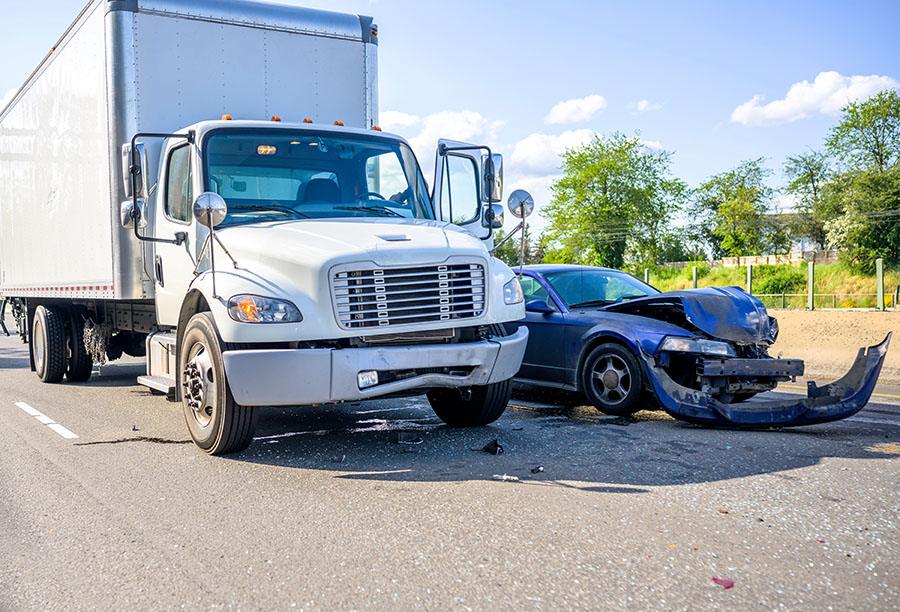
Collision of a semi truck with box trailer a passenger car on the highway road, as a result of which both cars were damaged, await the arrival of the police to draw up an accident report
The first 72 hours after a truck accident are the most important hours of your case — and the trucking company knows it. While you’re in the hospital, they’re already dispatching their rapid response team to the crash scene, downloading data from the truck’s electronic logging device, and coaching the driver on what to say. If you don’t act fast, critical evidence will disappear before your case even begins.
Truck accident cases are fundamentally different from car accident claims. The evidence is more complex, the defendants are more sophisticated, and the timeline for preserving key data is measured in hours, not weeks. Here’s what you need to do — and what the trucking company is doing while you’re doing it.
What the Trucking Company Is Doing Right Now
Before you’ve even been discharged from the hospital, the trucking company has likely already taken the following steps.
They’ve sent a rapid response team to the crash scene. Major trucking companies and their insurers have teams specifically trained to investigate accidents and protect the company’s interests. These aren’t neutral investigators — they’re building the defense case from minute one.
They’ve downloaded the electronic logging device (ELD) data. Federal law requires commercial trucks to use ELDs to record the driver’s hours of service. This data shows when the driver was driving, how long they’d been on duty, and whether they exceeded legal limits. Some older ELD systems overwrite data after a set period — and if the trucking company downloads the data before your attorney sends a preservation letter, they control what gets produced in discovery.
They’ve contacted the driver. The company’s attorneys or insurance adjusters have likely already spoken to the driver about what happened. By the time your attorney takes the driver’s deposition months later, the driver’s account will have been shaped by these early conversations.
They’ve contacted their insurance carrier. The insurance company is already evaluating the claim, setting reserves, and developing a strategy to minimize payout.
For a free legal consultation, call (303) 465-8733
What You Should Do
Hour 1-24: Medical Care and Scene Documentation
Get comprehensive medical treatment. Call 911 if you haven’t already. Even if you feel “okay,” get a full medical evaluation. Traumatic brain injuries, internal bleeding, and spinal cord injuries don’t always present symptoms immediately. Tell the medical team exactly how the accident happened and describe every symptom — headaches, dizziness, numbness, pain. This documentation becomes evidence.
Document the scene if you’re physically able. Photograph the truck (including the company name, DOT number, license plate, and any visible damage), your vehicle, the road conditions, skid marks, traffic signals, and any debris. If you can’t do this yourself, ask someone at the scene to take photos on your behalf.
Get the truck driver’s information. Name, employer, CDL number, insurance information, and DOT number. The DOT number is critical — it allows your attorney to pull the trucking company’s full safety record, including past violations and crash history.
Do not give a recorded statement. The trucking company’s insurance adjuster will contact you quickly. They’ll be friendly. They’ll say they just want to understand what happened. What they want is to get you on record saying something they can use against you. Politely decline and tell them to contact your attorney.
Hour 24-48: Legal Preservation
Contact a truck accident attorney. This is the single most important step, and it’s time-sensitive. The first thing your attorney will do is send a spoliation letter (evidence preservation demand) to the trucking company, the driver, the insurance carrier, and any other relevant parties. This letter puts them on legal notice that they must preserve all evidence related to the crash.
What gets preserved: ELD data and hours-of-service records, dashcam and forward-facing camera footage, driver qualification files (CDL, medical certification, employment history, drug/alcohol testing), vehicle maintenance and inspection records, dispatch communications (texts, emails, GPS data), cargo loading records and weight tickets, the truck’s event data recorder (EDR / black box), and any internal communications about the accident.
Without this letter, the trucking company can claim the data was routinely overwritten, the dashcam footage was recycled, or the maintenance records were archived and lost. With it, destroying evidence becomes spoliation — which carries serious legal consequences.
Hour 48-72: Building the Foundation
Follow up on medical treatment. Don’t skip follow-up appointments. Gaps in treatment give the insurance company ammunition to argue your injuries aren’t as serious as you claim.
Keep a symptom journal. Document how you feel each day — pain levels, cognitive difficulties, sleep problems, emotional changes. This contemporaneous record is powerful evidence of how the accident has affected your daily life.
Do not post on social media. The insurance company will monitor your social media accounts. A photo of you smiling at a family dinner can be used to argue you’re not in as much pain as you claim. Say nothing about the accident online.
Do not repair your vehicle yet. Your damaged vehicle is evidence. Preserve it in its current condition until your attorney has had it inspected and documented.
Why Truck Cases Demand Immediate Action
In a car accident, the key evidence is the police report, medical records, and vehicle damage — none of which are going anywhere. In a truck accident, the most valuable evidence is controlled by the defendant and has a limited shelf life.
ELD data can be overwritten. Dashcam footage is typically stored on a loop and recorded over within days or weeks. Driver qualification files may be altered. Maintenance records can conveniently disappear. The trucking company’s internal communications — emails between dispatch and the driver, messages about delivery deadlines, discussions about the driver’s performance — will be “routinely purged” if no one demands their preservation.
This is why we send preservation letters within hours of engagement. Jordan Law has recovered over $550 million for injury victims across Colorado, including truck accident verdicts of $26.6 million, $20 million, and $18.6 million. Those results started with evidence preservation in the first 72 hours.
The statute of limitations for truck accident claims in Colorado is 3 years (C.R.S. § 13-80-101). But don’t confuse that deadline with the timeline for preserving evidence. Three years is how long you have to file suit. Three days is how long you have before critical evidence starts disappearing.
Free Consultation — Call (303) 465-8733
If you were involved in a Colorado 18-wheeler accident, call our team of experienced attorneys. We’ve helped clients in Denver, Greenwood Village, Aurora, Arvada, Boulder, Fort Collins, Colorado Springs, Grand Junction and more.
Jordan Law Accident & Injury Lawyers 5445 DTC Parkway, Suite 1000, Greenwood Village, CO 80111