

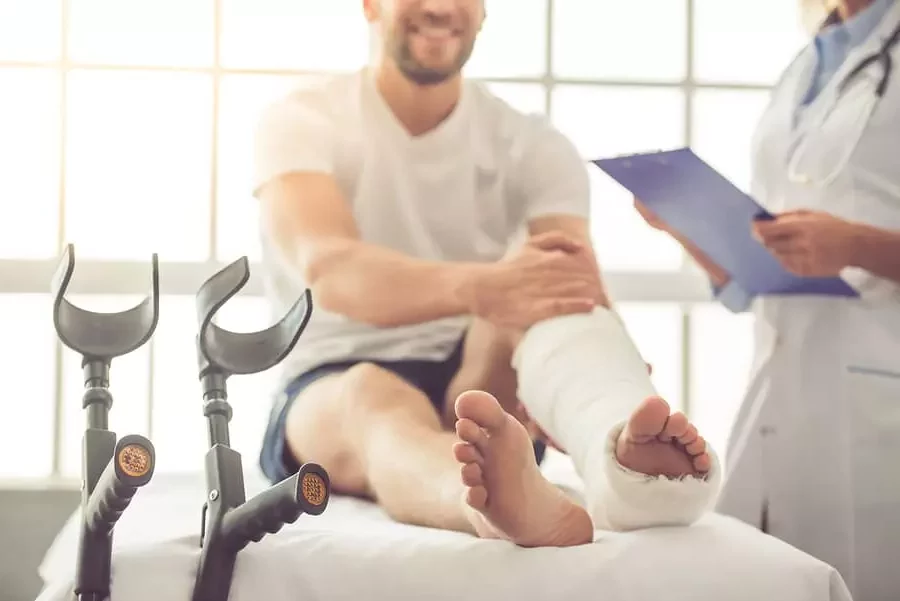
Insurance companies love to minimize broken bones. A fracture is “just a broken bone” — it’ll heal, you’ll be fine, here’s a lowball check. The reality is far more complicated, and accepting that narrative can cost you hundreds of thousands of dollars.
Broken bones are the most common serious injury across virtually every type of accident — car crashes, motorcycle collisions, pedestrian strikes, slip and falls, construction accidents, bicycle wrecks. But not all fractures are the same, and the difference between a clean break in your wrist and a shattered pelvis is the difference between a few months of recovery and a lifetime of chronic pain, hardware, and surgical revisions. Understanding fracture severity — and how it drives case value — is critical to getting the compensation you actually deserve.
Not All Fractures Are Equal
The word “fracture” covers an enormous range of injuries. Insurance adjusters know this, and they exploit it by treating every broken bone like a simple, predictable injury. Here’s what they don’t want you to understand.
Simple (closed) fractures are clean breaks where the bone doesn’t pierce the skin. These are the “best case” fractures — a cast or splint, 6-8 weeks of healing, and often a full recovery. Insurance companies love to value every fracture as if it were this type, even when it isn’t.
Comminuted fractures occur when the bone shatters into three or more fragments. These are common in high-energy impacts like car crashes and motorcycle accidents. Comminuted fractures almost always require surgery — often with plates, screws, and rods — and carry a high risk of chronic pain, arthritis, and the need for future hardware removal or revision surgery.
Compound (open) fractures are breaks where the bone pierces through the skin. These are medical emergencies with a high risk of infection, including osteomyelitis (bone infection) and MRSA. Open fractures frequently require multiple surgeries, extended antibiotic treatment, and can result in permanent disfigurement.
Compression fractures typically affect the vertebrae in the spine. They’re common in car accidents and falls, particularly among older adults. Spinal compression fractures can cause chronic back pain, loss of height, kyphosis (hunching), and in severe cases, nerve damage or paralysis.
Growth plate fractures affect children and adolescents whose bones are still developing. A fracture through a growth plate can disrupt bone growth, leading to limb length discrepancies, angular deformities, and long-term orthopedic problems that may require corrective surgery years after the initial injury.
Pelvic fractures are among the most serious fractures in the body. The pelvis protects major blood vessels and organs, and pelvic fractures — common in high-speed car crashes, pedestrian accidents, and motorcycle collisions — carry a risk of life-threatening internal bleeding, organ damage, and long-term mobility limitations.
Femur fractures (broken thighbone) require surgical repair with an intramedullary rod in almost every case. Recovery takes months, and many patients experience permanent changes in leg length, gait, and knee or hip function.
For a free legal consultation, call (303) 465-8733
Why Insurance Companies Undervalue Fractures
The insurance company’s playbook for fracture claims is predictable. They’ll argue the fracture was “simple” even when imaging shows comminution. They’ll claim you reached maximum medical improvement before your doctor says you have. They’ll ignore the future costs — hardware removal, arthritis treatment, revision surgery — that may not arise for years. And they’ll minimize the noneconomic impact by treating your injury as a temporary inconvenience rather than a permanent change to your physical capabilities.
Here’s what they don’t account for unless you force them to:
Hardware complications. Plates, screws, and rods can cause pain, irritation, and limited range of motion for years. Many patients eventually need hardware removal surgery — a second procedure with its own recovery period, risks, and costs.
Post-traumatic arthritis. Fractures that involve a joint surface — ankles, wrists, knees, hips — carry a significant risk of developing arthritis in the affected joint. This can manifest years after the fracture heals, creating ongoing pain, stiffness, and eventually the need for joint replacement.
Chronic pain. Even fractures that heal “well” on X-ray can produce chronic pain at the fracture site, especially in weight-bearing bones. Complex regional pain syndrome (CRPS) — a severe chronic pain condition — can develop after fractures, particularly in the wrist, ankle, and foot.
Loss of range of motion. Fractures near joints often result in permanent stiffness, even after physical therapy. A wrist fracture that heals with 20% less range of motion affects everything from typing to lifting to gripping a steering wheel.
Scarring from surgical repair. Open reduction and internal fixation (ORIF) surgery leaves scars. In visible locations — forearms, lower legs, face — surgical scars are compensable as disfigurement under Colorado law.
When a “Broken Bone” Is Actually a Catastrophic Injury
Some fractures cross the line from serious injury to catastrophic. These cases require attorneys with catastrophic injury experience and the resources to retain life-care planners, economists, and orthopedic specialists.
Spinal fractures that damage the spinal cord can result in partial or complete paralysis. Even spinal fractures without cord damage can require surgical fusion, permanent hardware, and chronic pain management.
Pelvic fractures with internal injuries — when the pelvis shatters and damages the bladder, urethra, or major blood vessels, the resulting injuries can be life-threatening and permanently disabling.
Multiple fractures from high-energy impacts — a motorcycle crash that breaks both legs, a pelvis, and several ribs isn’t a “broken bones” case. It’s a catastrophic injury case with potentially millions of dollars in lifetime medical costs.
Open femur or tibia fractures with compartment syndrome — when swelling within the muscle compartment cuts off blood flow, emergency fasciotomy (surgical opening of the compartment) is required. Delayed treatment can result in amputation.
Fractures in children affecting growth plates — the full impact may not be known for years, requiring long-term orthopedic monitoring and potentially corrective surgery during adolescence.
What Affects the Value of a Fracture Case in Colorado
The value of your broken bone case depends on several factors that go far beyond the initial X-ray.
Fracture type and location. A comminuted femur fracture requiring surgical repair is worth significantly more than a simple wrist fracture treated with a cast. Joint involvement, surgical hardware, and weight-bearing bone status all increase case value.
Medical treatment costs. Emergency care, surgery, hospital stays, follow-up imaging, physical therapy, and future treatment needs (hardware removal, arthritis management, joint replacement) all factor into economic damages — which have no cap in Colorado.
Lost wages and earning capacity. Time missed from work during recovery, reduced earning capacity if you can’t return to your previous job, and the economic impact of permanent physical limitations.
Age and activity level. A 30-year-old construction worker with a comminuted ankle fracture faces decades of arthritis, potential joint replacement, and career limitations. A retired person with the same fracture has different — but still significant — quality-of-life impacts.
Noneconomic damages. Pain and suffering, loss of enjoyment of life, and emotional distress. Under HB 24-1472, noneconomic damages in Colorado are capped at approximately $1.5 million, with the potential to exceed the cap on clear and convincing evidence.
Comparative negligence. Colorado’s modified comparative negligence rule (C.R.S. § 13-21-111) reduces your recovery by your percentage of fault. At 50% or more fault, you recover nothing. Insurance companies will aggressively argue comparative negligence to reduce what they owe.
Fractures Across Different Accident Types
Broken bones occur in virtually every type of accident we handle. If your fracture resulted from someone else’s negligence, you may have a claim:
Car accidents — steering column impacts, dashboard compression, seatbelt loading injuries, and ejection all produce fractures. Wrist, forearm, clavicle, rib, pelvis, and femur fractures are the most common.
Truck accidents — the force of a commercial truck collision produces the most severe fractures we see, including multiple comminuted fractures, pelvic ring disruptions, and spinal injuries.
Motorcycle accidents — riders absorb the full impact with no structural protection. Tibial plateau fractures, femur fractures, wrist fractures from bracing, and pelvic fractures are extremely common.
Pedestrian accidents — “bumper fractures” of the tibia and fibula are a hallmark of pedestrian crashes, along with pelvic, hip, and spinal fractures from being thrown onto the hood or pavement.
Slip and fall accidents — wrist fractures (Colles fractures from catching yourself), hip fractures (especially in older adults), ankle fractures, and spinal compression fractures.
Construction accidents — falls from heights produce calcaneus (heel) fractures, spinal compression fractures, and multiple extremity fractures. Struck-by incidents cause skull, rib, and long bone fractures.
Bicycle accidents — clavicle fractures, wrist fractures, and facial fractures are the most common cycling injuries, often accompanied by traumatic brain injury.
Click to contact our personal injury lawyers today
Don’t Accept the Insurance Company’s First Offer
If you’ve suffered a broken bone in an accident caused by someone else’s negligence, the insurance company’s first offer will almost certainly undervalue your claim. They’ll calculate your current medical bills, maybe add a small multiplier, and present it as a fair number. What they won’t include — unless you have an attorney who forces the issue — is the future cost of hardware removal, the arthritis you’ll develop in five years, the earning capacity you’ve lost, and the permanent changes to your physical capabilities and quality of life.
At Jordan Law, we’ve recovered over $550 million for injury victims across Colorado, including a $131 million verdict, a $45 million settlement, and a $42 million verdict. We work with orthopedic specialists, life-care planners, and economists to ensure that every element of your fracture’s long-term impact is documented, calculated, and presented — whether in settlement negotiations or at trial.
The statute of limitations for motor vehicle accidents is 3 years (C.R.S. § 13-80-101). For general personal injury claims including slip and falls, it’s 2 years (C.R.S. § 13-80-102). Don’t wait until the deadline is close — evidence disappears and medical records become harder to connect to the accident over time.
Free Consultation — Call (303) 465-8733
Jordan Law Accident & Injury Lawyers 5445 DTC Parkway, Suite 1000 Greenwood Village, CO 80111