


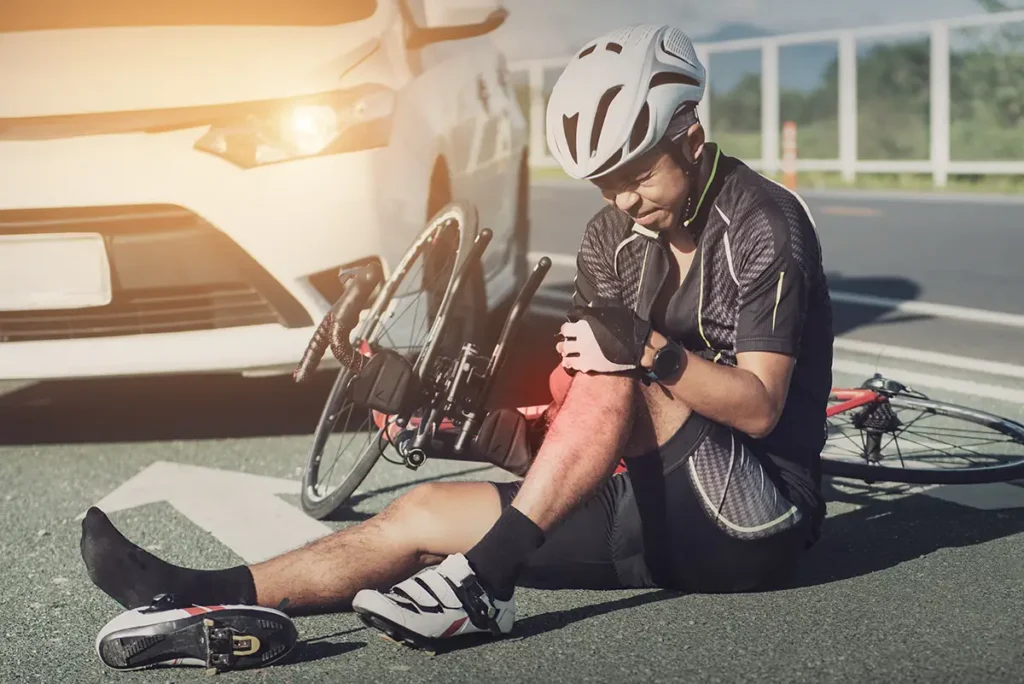
The driver’s insurance company will try to blame you. That’s not speculation — it’s standard operating procedure. In virtually every bicycle-versus-car case, the insurer’s first move is to argue the cyclist was partially or fully at fault. Understanding how fault actually works in Colorado — and how different crash scenarios affect liability — is your best defense against those tactics.
Colorado’s modified comparative negligence rule (C.R.S. § 13-21-111) means fault can be shared between the driver and the cyclist. Your compensation is reduced by your percentage of fault, and at 50% or more fault, you recover nothing. That makes every percentage point worth fighting over — and it makes understanding the fault dynamics of different crash scenarios essential.
The Default Rule: Drivers Are Usually at Fault
Let’s start with the baseline. Under C.R.S. § 42-4-1412, bicycles are vehicles under Colorado law, and cyclists have the same rights as motorists on public roads. When a driver strikes a cyclist, the analysis is the same as a car-versus-car collision: who violated a traffic law, who failed to exercise reasonable care, and whose negligence caused the crash?
In the majority of bicycle-car collisions, the driver is at fault. The most common driver negligence patterns include failure to yield at intersections, turning across the cyclist’s path (left-cross and right-hook), opening a car door into the cyclist’s path (dooring), passing too closely (violating the three-foot law), distracted driving, running red lights or stop signs, and impaired driving.
Each of these constitutes a traffic law violation that can establish negligence per se — meaning the driver’s fault is presumed based on the statutory violation alone.
For a free legal consultation, call (303) 465-8733
Scenario-by-Scenario Fault Analysis
Left-Cross: Driver Turns Left Into Cyclist’s Path
Fault: Almost always the driver. The driver making a left turn has a duty to yield to all oncoming traffic — including bicycles. When a driver misjudges the cyclist’s speed and turns across their path, the driver violated the cyclist’s right-of-way. This is one of the clearest liability scenarios in bicycle law.
Insurance company defense: “The cyclist was going too fast” or “The cyclist came out of nowhere.” We counter with speed calculations from the crash dynamics, witness testimony, and the fact that the cyclist was traveling in a lawful, expected lane of traffic.
Right-Hook: Driver Turns Right Across Bike Lane
Fault: Almost always the driver. A driver who turns right must check for cyclists in the bike lane before executing the turn. Failure to do so is negligence. Colorado law doesn’t exempt drivers from checking for bikes just because they’re in a bike lane.
Insurance company defense: “The cyclist was in the driver’s blind spot.” We counter with the driver’s duty to check mirrors and blind spots before turning, and the fact that the cyclist was in a designated bike lane doing exactly what they’re supposed to do.
Dooring: Driver Opens Door Into Cyclist
Fault: The person who opened the door — always. C.R.S. § 42-4-1207 makes it illegal to open a vehicle door into moving traffic unless it’s safe to do so. This is negligence per se. The door-opener is liable, period.
Insurance company defense: “The cyclist should have ridden farther from parked cars.” We counter with the fact that bike lanes are often positioned within the door zone by design, and the cyclist was riding where the infrastructure directed them to ride.
Rear-End: Driver Hits Cyclist from Behind
Fault: Almost always the driver. Just as with car-versus-car rear-end collisions, the following vehicle is presumed at fault because they had a duty to maintain a safe following distance and react to traffic ahead of them. When a distracted, speeding, or inattentive driver strikes a cyclist from behind, liability is clear.
Insurance company defense: “The cyclist was riding erratically” or “The cyclist stopped suddenly.” We counter with the fact that cyclists have every right to use the road and that the driver had a duty to maintain safe distance regardless of the cyclist’s behavior.
Cyclist Runs a Red Light or Stop Sign
Fault: Potentially the cyclist — but it depends. If a cyclist blows a red light and a driver with a green light strikes them, the cyclist likely bears the majority of fault. However, Colorado’s Safety Stop law allows cyclists to treat stop signs as yield signs and red lights as stop signs, provided they have the right-of-way. If the cyclist was following the Safety Stop law — stopping at the red, confirming it was safe, and proceeding — they were not violating any law.
Insurance company tactic: Insurers will claim the cyclist “ran a red light” without acknowledging the Safety Stop law. We present the specific facts: did the cyclist stop? Was the intersection clear? Did they have the right-of-way? Context matters.
Cyclist Riding Against Traffic (Wrong Way)
Fault: Shared or primarily the cyclist. Riding against the flow of traffic is illegal in Colorado and dramatically increases crash risk because drivers don’t expect traffic coming from the wrong direction. A cyclist riding the wrong way on a one-way street or against traffic on an arterial road will likely bear significant comparative negligence.
However, the driver may still share fault if they were speeding, distracted, or failed to react when the cyclist was visible. A wrong-way cyclist doesn’t give the driver a license to hit them.
Cyclist Riding Without Lights at Night
Fault: Shared. Colorado law (C.R.S. § 42-4-204) requires bicycles to have a white front light visible from 500 feet and a red rear reflector visible from 600 feet when riding at night. A cyclist without proper lighting who is struck at night will face comparative negligence arguments.
But: the driver still has a duty to watch for road users and operate at a safe speed for conditions. Darkness doesn’t eliminate the driver’s responsibility. The fault allocation depends on the specific facts — how visible was the cyclist despite the missing lights? Was the area well-lit by streetlights? Was the driver speeding or distracted?
Cyclist Not Wearing a Helmet
Fault for the crash: No effect. Helmet use (or non-use) has nothing to do with who caused the accident. Colorado does not require adult cyclists to wear helmets (C.R.S. § 42-4-1502).
Effect on damages: Potentially significant. Insurance companies will argue that the cyclist’s head injuries would have been less severe with a helmet — a “failure to mitigate” argument designed to reduce noneconomic damages. This argument doesn’t bar your claim, but it can reduce the pain-and-suffering component. We counter with biomechanical evidence about the actual mechanism of injury.
Road Hazard Causes the Crash (No Driver Involved)
Fault: The government entity or property owner responsible for maintaining the road. Potholes in bike lanes, missing signage, construction zones without detours, and dangerous trail crossings can all cause bicycle crashes without a vehicle being involved. Claims against government entities require a 182-day CGIA notice — miss this deadline and the claim is barred.
How Colorado’s Comparative Negligence Rule Affects Your Recovery
Even when the driver is primarily at fault, the insurance company will argue you were partially responsible — riding too fast, not wearing high-visibility gear, not signaling, or not being “predictable enough.” Under C.R.S. § 13-21-111, your recovery is reduced by your percentage of fault. At 50% or more, you get nothing.
This is why the specific facts matter so much. The difference between 20% fault and 40% fault on a $500,000 claim is $100,000. Insurance companies know this, and they’ll use every available argument to push your fault percentage higher.
At Jordan Law, we counter these tactics with accident reconstruction, surveillance footage from nearby businesses, traffic signal timing analysis, GPS and cycling computer data, vehicle EDR (black box) data showing the driver’s speed, and phone records proving the driver was distracted. The goal is to pin fault where it belongs — on the driver who caused the crash.
What to Do After a Bicycle-Car Collision
Call 911 and get medical attention — even if you feel okay. Traumatic brain injuries and internal bleeding don’t always present symptoms immediately. Document everything — photograph the scene, the vehicle, your injuries, the bike lane markings, and traffic signals. Get the driver’s information — name, insurance, license plate. Get witness contact information. Do not give a recorded statement to the driver’s insurance company. And contact a bicycle accident attorney before the insurer starts building its case against you.
Jordan Law has recovered over $550 million for injury victims across Colorado. We handle every bicycle accident case on a contingency fee basis — you pay nothing unless we win.
Need a Denver Bicycle accident lawyer? Free Consultation — Call (303) 465-8733
Jordan Law has 20 years of experience helping bicycle accident victims throughout Colorado, including cities such as Greenwood Village, Denver, Colorado Springs, Fort Collins, Grand Junction, Arvada, Aurora, and Boulder.
Jordan Law Accident & Injury Lawyers 5445 DTC Parkway, Suite 1000, Greenwood Village, CO 80111