




How Distracted Driving Cases Are Proven Without a Police Citation
Here’s something we tell people in Greenwood Village almost every week. A police citation is helpful, but you don’t need one to win a distracted driving accident case.
Officers show up after the crash. They didn’t see the driver scrolling through their phone. They didn’t watch the person reach into the back seat for a coffee. So the police report might just say “failure to yield” or “following too closely.” It won’t mention distraction at all. Adjusters will point to that clean report like it proves their driver did nothing wrong. Most people don’t know that’s a tactic.
We prove distraction a different way. Cell phone records are the big one. Under Colorado’s hands-free driving law (SB 24-065), using a phone while driving is now illegal. But proving the phone was active at the moment of impact takes subpoena work. We pull carrier records showing texts, calls, and data usage down to the second. App activity logs from social media or navigation apps can place the phone in the driver’s hand right when they hit you.
And that’s just the start. Dashcam footage from nearby vehicles along corridors like Arapahoe Road or Orchard Road often captures the other driver looking down. Traffic cameras near the DTC Parkway interchange have caught drivers drifting lanes. Witness statements matter too. The person in the next lane who saw the driver’s face lit up by a screen. That testimony carries real weight.
Event data recorders in newer vehicles tell us whether the driver braked at all before impact. No braking on a clear day with stopped traffic ahead? That’s a distraction pattern we’ve seen play out hundreds of times. We also look at the driver’s phone for deleted messages, because people panic and try to erase evidence after a crash.
Nine times out of ten, the proof is there. It just takes knowing where to look and moving fast before records get overwritten or devices get wiped. Our team sends preservation letters within days of taking a case. That locks down the evidence before it disappears.
For a free legal consultation with a car accident lawyer serving Greenwood Village, call (303) 465-8733
Evidence Preservation in the First 72 Hours After a DTC-Area Crash
The clock starts running the second that crash happens. Most people don’t realize how fast key evidence disappears in Greenwood Village.
We see this play out every single week. Someone gets rear-ended near the Orchard Road interchange because the other driver was scrolling their phone. They go to the ER, they rest for a couple days, they call us on day four. By then, the traffic camera footage from CDOT along I-25 may already be gone. Surveillance video from nearby office buildings in the DTC gets overwritten on loops as short as 48 to 72 hours. That footage showing the other driver looking down at their lap? It won’t exist by next Monday.
Here’s what needs to happen fast. Cell phone records are the backbone of a distracted driving accident lawyer case, but carriers don’t preserve usage logs unless someone sends a formal preservation letter. We send those within hours of taking a case. Vehicle data matters too. Most newer cars have event data recorders that capture speed, braking, and steering inputs in the seconds before impact. If the at-fault driver’s car gets repaired or totaled before that data is pulled, it’s lost for good. Witness statements fade quickly. The person in the car behind you who saw the other driver texting might remember details clearly today. In three weeks, not so much.
Colorado’s hands-free driving law, SB 24-065, makes manual phone use behind the wheel illegal. But proving a violation requires evidence that existed at the moment of the crash. A police report that says “driver distracted” helps. Actual cell tower pings and app usage logs showing the driver had Instagram open at 5:47 PM on DTC Parkway? That wins cases.
As your accident and injury attorney, our team sends preservation letters to insurance companies, cell carriers, and businesses with cameras near the crash site. We do it the same day you call. Not sure if you’ve waited too long? Call us and let’s find out. Some evidence can still be recovered even after a short delay, but every hour matters.
Colorado’s Hands-Free Law and What It Means for Your Claim
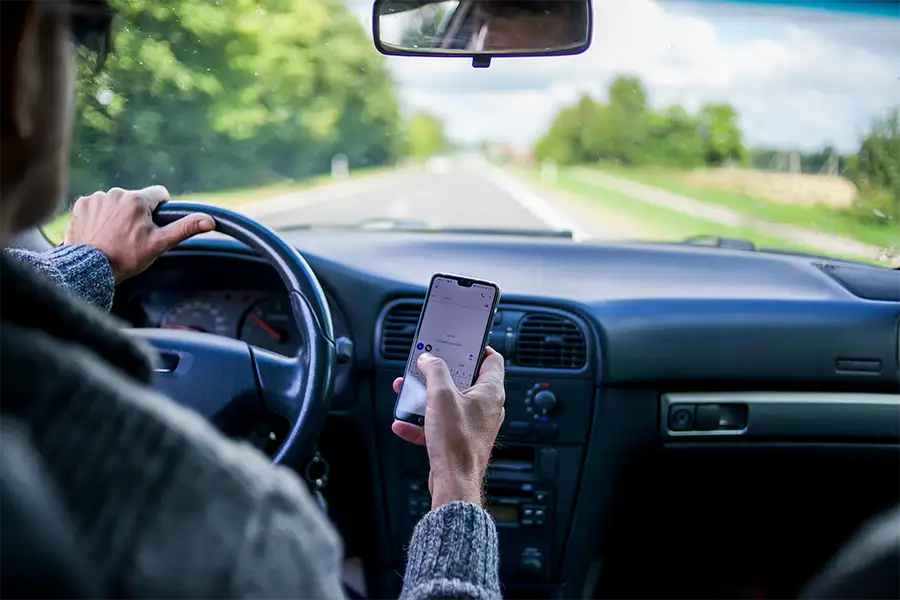
SB 24-065 changed everything. Colorado’s hands-free driving law now makes it illegal to hold a phone while driving. Not just texting. Holding it. Scrolling. Swiping. Even holding it up to your ear on a call. If the driver who hit you had a phone in their hand, they broke the law. Period.
We see this come up in almost every distracted driving accident case we handle in Greenwood Village now. And it’s a big deal for your claim because violating a traffic safety statute in Colorado is what’s called “negligence per se.” That means the other driver doesn’t just look careless. They’re legally presumed negligent. You don’t have to prove they should have known better. The statute does that work for you.
But here’s what most people don’t realize going into this. Adjusters will still try to flip the script. They’ll argue you were also on your phone, that you failed to brake in time, that you were changing lanes near the Orchard Road interchange without signaling. Colorado’s modified comparative negligence rule under C.R.S. § 13-21-111 means they only need to push your fault to 50% to wipe out your recovery entirely. So even with a hands-free violation on their side, the adjuster’s job is to muddy the water.
That’s why phone records matter so much. We subpoena cell carrier records, pull app usage data, and request any dashcam or traffic camera footage from the area. Along the DTC Parkway corridor and near Fiddler’s Green, there are cameras and witnesses everywhere. The evidence exists. It just has to be grabbed fast before it disappears.
One thing people miss. A hands-free violation can also open the door to punitive damages under C.R.S. § 13-21-102 if the behavior was reckless enough. Texting at 55 mph through a Greenwood Village intersection while rear-ending a stopped car isn’t just negligent. A jury can see that for what it is.
If you’ve got questions about how the hands-free law applies to your crash, give us a call. We can usually tell you where you stand in one conversation.
Greenwood Village Car Accident Lawyer Near Me (303) 465-8733
Corporate and Rideshare Driver Accidents Along the Orchard Road Corridor
Orchard Road between I-25 and Holly Street sees a constant stream of corporate fleet vehicles, Uber drivers, and Lyft cars moving through Greenwood Village during rush hours. We handle distracted driving cases along this corridor regularly. The pattern is almost always the same. A driver for a company or a rideshare platform glances at a dispatch screen, a GPS reroute, or a passenger rating notification. They rear-end someone at the Orchard and Yosemite intersection or drift into the next lane near the Village Inn shopping area.
These cases are different from a typical distracted driving claim because there’s often a second liable party beyond the driver.
Corporate fleet drivers may be employees acting within the scope of their job. That means the employer can be held responsible under respondeat superior. If a sales rep for a DTC company is texting a client while driving on Orchard Road and hits you, the company’s insurance is on the hook. We dig into whether the employer had a hands-free policy, whether they enforced it, and whether the driver had prior incidents. Colorado’s hands-free law under SB 24-065 makes phone use behind the wheel illegal, so a violation is strong evidence of negligence.
Rideshare accidents add a layer of insurance complexity. Uber and Lyft carry $1 million liability policies, but only when the driver has accepted a ride or is transporting a passenger. If the driver was just cruising with the app open, coverage drops dramatically. Many people don’t know which coverage phase applies to their crash. We pull the driver’s app data to pin down the exact moment of the crash relative to their trip status.
And here’s what catches people off guard. Colorado’s modified comparative negligence rule under C.R.S. § 13-21-111 means the other side will try to pin fault on you. They’ll argue you stopped short or failed to signal. If they push your fault to 50% or higher, you recover nothing. We’ve seen rideshare insurers use this tactic aggressively along the Orchard corridor because multi-lane traffic and frequent lane changes give them room to create doubt. Getting the driver’s phone records and app logs early shuts that argument down fast.

What Happens After You Contact Jordan Law for Your Case
You pick up the phone or fill out the form. Then what? That’s the real question, so here’s exactly how it works.
The first call is free and it’s fast. You’ll talk to someone on our team who handles distracted driving cases in Greenwood Village every week. Not a call center. Not a receptionist reading a script. We’ll ask what happened, where it happened, and what you’re dealing with right now. Medical bills piling up, can’t drive to work, pain that won’t quit. We listen to all of it.
If your case has merit, we move quickly. Sarah Freedman, our Director of Pre-Litigation, and her team start building your file the same day. That means sending preservation letters to the other driver’s insurance company so they can’t destroy phone records or dashcam footage. It means pulling the police report from Greenwood Village PD and identifying every witness listed. We’ve seen phone data vanish when carriers purge records after 60 to 90 days, so waiting is the enemy.
You don’t pay us anything upfront. We work on contingency. If we don’t recover money for you, you owe us nothing. That’s not a gimmick. It’s how we’ve always operated.
Here’s something most people don’t realize going in. The insurance adjuster assigned to your claim already has a playbook. They’ll call you sounding friendly. They’ll ask for a recorded statement. They’ll make an offer before you even know the full extent of your injuries. Our job is to make sure that playbook doesn’t work on you.
“Insurance companies know which firms actually take cases to trial, and that affects how your case is handled. A lot of the high-volume firms don’t actually try cases. In fact, many times they end up calling firms like ours to litigate and take their cases to trial.”, Jason Jordan, Founding Partner
Our office sits right here in Greenwood Village at 5445 DTC Parkway. You can walk in. You can call. You can do a video consult from your couch near the Landmark. Whatever works for you. But don’t let the three-year statute of limitations under C.R.S. § 13-80-101 trick you into thinking you have plenty of time. Evidence fades. Witnesses forget. The sooner we start, the stronger your case gets.
Click to contact our Denver Personal Injury Lawyerss today
Our Greenwood Village, Colorado Office Location

Our main office is located in Greenwood Village, also known as the Denver Tech Center, just south of Downtown Denver.
Jordan Law Accident and Injury Lawyers
5445 DTC Parkway Suite 1000 Greenwood Village CO 80111
Frequently Asked Questions
Do I need a police citation to file a distracted driving claim in Greenwood Village?
No, a police citation is not required to file a distracted driving accident claim in Greenwood Village.
You do not need a police citation to pursue a distracted driving accident claim in Greenwood Village. Law enforcement rarely witnesses the distraction directly, and crash reports often list generic causes. A skilled attorney can build a strong case using cell phone records, app activity logs, dashcam footage, and witness statements — evidence that can be far more compelling than a citation alone.
How fast does evidence disappear after a crash near the DTC area?
Critical evidence from a distracted driving accident near the DTC area can vanish within 48 to 72 hours.
After a distracted driving accident near the DTC area, time is your biggest enemy. Surveillance footage from nearby office buildings gets overwritten quickly, CDOT camera footage along I-25 may be gone within days, and cell carriers do not preserve usage logs without a formal preservation letter. Acting immediately after your distracted driving accident gives your attorney the best chance of securing evidence before it disappears permanently.
What does Colorado’s hands-free law mean for my accident claim?
Colorado’s hands-free law means that if the other driver was holding their phone, they are legally presumed negligent in your distracted driving accident claim.
Under Colorado’s hands-free law (SB 24-065), holding a phone while driving is illegal, and violating it constitutes negligence per se — meaning the driver is automatically considered negligent. For victims of a distracted driving accident in Greenwood Village, this significantly strengthens your claim. However, insurance adjusters will still attempt to shift blame, so securing strong phone record evidence through an experienced attorney remains critically important.
Can the other driver delete their texts to hide evidence after a crash?
Deleting texts does not eliminate the recoverable evidence in a distracted driving accident case, as carrier records and app logs preserve the data.
Even if the other driver attempts to delete texts after a distracted driving accident, that evidence is rarely gone for good. Cell carrier records document calls, texts, and data usage to the exact second. Social media and navigation app activity logs can pinpoint phone use at the precise moment of impact. Attorneys acting quickly can send preservation letters to lock down device data before any wiping occurs, protecting your case.
What should I do in the first few days after a distracted driving accident in Greenwood Village?
After a distracted driving accident in Greenwood Village, your top priorities are seeking medical attention, contacting an attorney immediately, and avoiding recorded statements to the insurance company.
The first 72 hours following a distracted driving accident in Greenwood Village are the most critical. Seek medical care right away and document every appointment. Contact an attorney as soon as possible so preservation letters can be sent before key evidence disappears. Write down everything you remember about seeing the other driver on their phone while details are still fresh, and never give a recorded statement to the opposing insurer before speaking with legal counsel.
Can I still recover damages if I was partly at fault for the crash?
Yes, you can still recover damages after a distracted driving accident even if you were partially at fault, thanks to Colorado’s modified comparative fault rule.
Colorado follows a modified comparative fault system, meaning you can recover damages in a distracted driving accident as long as you are less than 50% responsible for the crash. Your compensation is reduced by your percentage of fault, but you are not barred from recovery entirely. This makes it especially important to work with an experienced attorney who can minimize your assigned fault percentage and maximize the damages you receive.