



Colorado's Motorcycle Crisis: Record Fatalities, Rising Risks
Motorcycle accidents produce some of the worst injuries on the road — and riders face bias from insurance companies, jurors, and the legal system from day one. Jordan Law has won $45M, $42M, and $21.6M motorcycle verdicts because we know how to fight for riders. We’ve handled hundreds of motorcycle cases, and we treat every one like it matters.
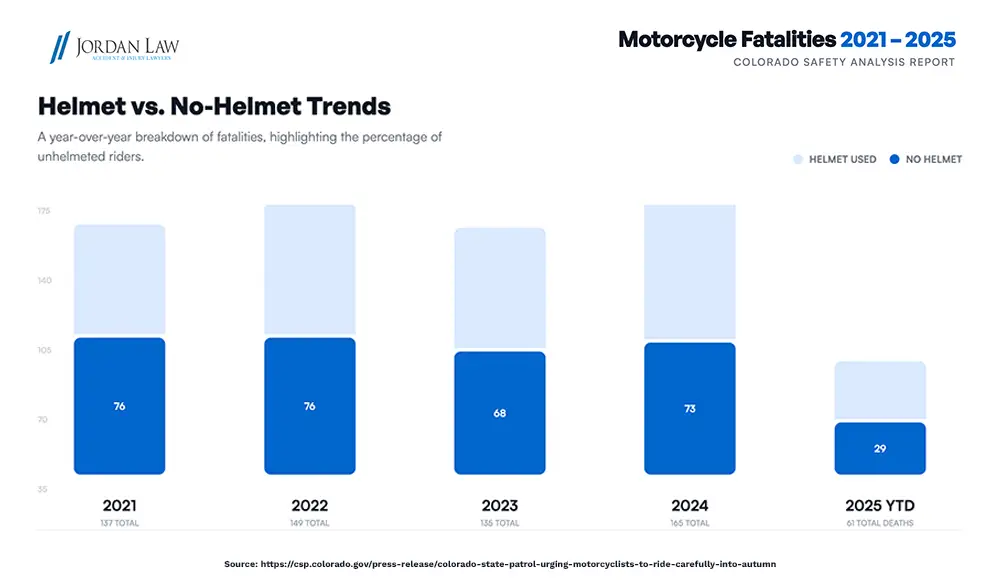
In 2024, 165 motorcyclists were killed on Colorado roads — the highest number ever recorded in the state, and a 57% increase since 2015. Motorcycle riders account for just 3% of vehicles on Colorado’s roads, yet they represent nearly one-quarter of all traffic fatalities. September 2024 alone claimed 33 motorcyclists’ lives — the deadliest single month on record.
The numbers tell a devastating story. Motorcyclists are 29 times more likely to die in a crash than passenger vehicle occupants. When a collision happens on I-25, I-70, Colfax Avenue, or any of Denver’s busy corridors, the rider absorbs the full force of impact with nothing between them and the road. The injuries — traumatic brain injuries, spinal cord damage, severe road rash, crushed limbs, internal organ damage — are frequently catastrophic and life-altering.
At Jordan Law, we’ve represented hundreds of motorcycle accident victims throughout Colorado. We understand the unique medical, legal, and cultural challenges these cases present — including the anti-rider bias that insurance companies exploit to minimize what they pay. We’re trial lawyers who prepare every motorcycle case with the depth and rigor it deserves, because insurance companies negotiate differently when they know you’re willing to go to court.
“Motorcycle accidents are often the worst type of accidents that we see. And that just makes sense, right? You don’t have the padding, the protection of a vehicle around you. So when you’re in a motorcycle accident, usually the injuries are pretty bad and sometimes catastrophic. You know, we see signs all the time, “look twice, save a life.” It’s very common — left hand turn cases. A person makes a left, they just didn’t see the motorcycle, they didn’t look, they were a smaller target. Unfortunately, the outcome of that can be incredibly catastrophic.”
Jason Jordan, Esq. – Founding Partner, Jordan Law
165
Motorcyclists killed on Colorado roads in 2024 — the highest number ever recorded. Motorcycle deaths have risen 57% since 2015, with 44% of those killed not wearing a helmet.
For a free legal consultation with a Personal Injury lawyer serving Denver, call (303) 465-8733
Our Motorcycle Accident Track Record
Results matter — both for what they mean to our clients and because insurance companies track which firms actually take motorcycle cases to verdict. Jordan Law’s motorcycle accident results include:
- Settlement for a young man who suffered catastrophic injuries when struck by another driver while riding to work
- A car made a left turn in front of a motorcycle, ejecting the rider and passenger
- Jury verdict in a contested motorcycle collision case
These results didn’t happen by accident. In every case, the insurance company initially offered far less than what our clients deserved. Our willingness to prepare for trial — and to actually try the case when necessary — is what produced these outcomes.
“It’s very important that you wind up with the right attorney — not just the attorney that advertises the most or has the most clicks on the Internet. You want to go with an attorney that has tried cases, because the insurance carriers know which law firms try cases and you get better value on your case. And a lot of the ones that are running those big volumes, they don’t try anything. In fact, a lot of times they’re calling us to litigate and try their cases.”
Jason Jordan, Esq. – Founding Partner, Jordan Law
The Anti-Rider Bias Problem — and How We Fight It
One of the most significant challenges in motorcycle accident cases isn’t legal — it’s cultural. Many people carry deep biases against motorcyclists. Insurance adjusters, defense attorneys, and potential jurors often assume that riders are inherently reckless, that they brought the crash on themselves, or that choosing to ride a motorcycle means accepting the risk of injury. This bias directly affects how much compensation victims receive.
“There’s also a bit of a stigma that goes along with those cases where you see motorcycle riders, some people — some of these younger guys flying around doing wheelies or doing crazy stuff on the highway — and suddenly everyone is that person in your mind. Right? It plays into the biases that people have, that motorcycle riders are just crazy and taking these crazy risks. When really they have just as much right to the road as anyone else.”
Jason Jordan, Esq. – Founding Partner, Jordan Law
Insurance companies weaponize this bias. They’ll argue that the rider was speeding (even without evidence), that they were weaving through traffic, or that they should have been “more visible.” If the rider wasn’t wearing a helmet — which is legal in Colorado for anyone 18 and older — the insurer will almost certainly try to reduce the claim by arguing the injuries would have been less severe.
At Jordan Law, we confront anti-rider bias head-on. We present evidence of the rider’s experience, training, safety gear, and responsible riding history. We demonstrate that the other driver — not the motorcyclist — was negligent. We use accident reconstruction experts to show how the collision actually happened, not how the insurance company wants a jury to imagine it happened. And when we take these cases to trial, we address bias directly in jury selection, opening statements, and witness examination.
Colorado’s Comparative Negligence Rule
Colorado follows a modified comparative negligence standard, which means your compensation is reduced by your percentage of fault — but only if you’re found to be less than 50% responsible for the crash. Insurance companies use this rule aggressively in motorcycle cases, trying to shift blame to the rider to reduce what they pay. Having an attorney who understands this dynamic and can effectively counter comparative negligence arguments is essential to protecting your recovery.
Denver Motorcycle Accident Lawyer Near Me (303) 465-8733
Colorado Motorcycle Laws That Affect Your Case
Helmet Law
Colorado does not require riders over 18 to wear a helmet. However, riders under 18 must wear a helmet, and all riders must wear eye protection. While riding without a helmet is legal, insurance companies routinely use the absence of a helmet to argue for reduced compensation. Jordan Law has extensive experience countering this tactic — we document all protective gear the rider was using and present evidence on the actual cause and mechanism of injury.
Lane Filtering Law (2024)
In 2024, Colorado passed a new law allowing motorcycles to filter between vehicles that are stopped on the roadway. This is an important distinction: lane filtering (moving between stopped vehicles) is now legal, while lane splitting (moving between vehicles that are in motion) remains illegal. The lane filtering law was designed to reduce the risk of motorcyclists being rear-ended in stopped traffic — a common and particularly dangerous type of crash. If you were lane filtering legally and were struck by another vehicle, you have a strong negligence claim against the driver who hit you.
Three-Year Statute of Limitations
In Colorado, you generally have three years from the date of the accident to file a personal injury claim, and two years for wrongful death claims. However, evidence deteriorates quickly in motorcycle cases — road conditions change, surveillance footage gets overwritten, and witness memories fade. The sooner you contact an attorney, the stronger your case will be.
29x
Common Causes of Motorcycle Accidents in Denver
The most frequent motorcycle crash scenario in Colorado is depressingly predictable: a driver turns left in front of an oncoming motorcycle. The driver says they “didn’t see” the rider. The motorcyclist, traveling at legal speed with the right of way, has no time to react. The results are catastrophic.
Other common causes of motorcycle accidents in the Denver metro area include:
Distracted driving — drivers on their phones, eating, adjusting GPS, or otherwise not watching the road. With Colorado’s hands-free law now in effect, a driver caught holding their phone has clearly violated state law, strengthening your negligence claim.
Failure to yield — drivers pulling out of driveways, parking lots, or side streets without checking for motorcycles. Motorcycles present a smaller visual target, and many drivers simply don’t look for them.
Unsafe lane changes — drivers merging into a motorcycle’s lane without checking blind spots. This is especially common on I-25 and I-225 during rush hour traffic.
Rear-end collisions — a vehicle striking a motorcycle from behind at a stoplight or in slowed traffic. Colorado’s new lane filtering law was designed to reduce this specific type of crash.
Impaired driving — 20% of Colorado’s motorcycle fatalities in 2024 involved impairment. Drunk and drugged drivers pose an extreme threat to motorcyclists because of their reduced reaction time and impaired judgment.
Speeding — both by other drivers and, in some cases, by riders. Speed was a top contributing factor in Colorado’s record 165 motorcycle fatalities in 2024.
Road hazards — potholes, gravel, oil spills, uneven pavement, and construction debris that a car might drive over safely can be deadly for a motorcycle. When a government entity is responsible for road maintenance, the 182-day CGIA notice deadline applies.
Click to contact our personal injury lawyers today
Injuries Common in Motorcycle Accidents
Because motorcycles offer no structural protection, the injuries riders sustain are typically far more severe than in car accidents. Common motorcycle crash injuries include:
Traumatic brain injuries — even with a helmet, the violent forces of a motorcycle crash can cause concussions, brain bleeds, and diffuse axonal injuries. Without a helmet, the risk of fatal or permanently disabling brain injury increases dramatically. Jordan Law has recovered over $130 million in brain injury verdicts and has deep experience with these complex cases.
Spinal cord injuries — damage to the spinal cord can result in partial or complete paralysis. These are life-altering injuries that require lifetime medical care and dramatically affect earning capacity.
Road rash — when a rider slides across pavement, the friction can strip away multiple layers of skin, requiring extensive skin grafting surgery and leaving permanent scarring. Severe road rash can cause nerve damage and infection.
Broken bones and crush injuries — compound fractures of the femur, tibia, pelvis, and arms are common when a motorcycle is struck by a vehicle. These injuries often require multiple surgeries and extended rehabilitation.
Internal organ damage — the blunt force of a motorcycle collision can rupture the spleen, liver, or kidneys, causing life-threatening internal bleeding that may not be immediately apparent.
Amputation — in the most severe crashes, limbs may be crushed or severed. Even when emergency surgery can save a limb, the long-term functional impairment and chronic pain can be devastating.
Psychological trauma — PTSD, anxiety, depression, and phobias (particularly around riding or even being near traffic) are common after serious motorcycle crashes and are compensable damages in your case.
“What I like to tell clients is the best thing they can do for their case: give us as much information as you can. Tell us how you’re feeling. Tell us how medical visits are going. Tell us what life is like at home because of your injuries. Tell us if you’re not feeling like yourself, if you’re feeling foggy, you just seem a little off lately. We really want you to share that information with us because it helps us understand your story — so we can tell the jury one day what you’ve been through.”
Michael Harris, Esq. – Litigation Attorney, Jordan Law
What to Do After a Motorcycle Crash
Get Medical Attention — Even If You Think You’re Okay
Adrenaline masks pain. Internal injuries, brain injuries, and spinal injuries may not show symptoms for hours or days. Go to the emergency room. Get evaluated thoroughly. Tell your doctor about every impact, every area of pain, and the mechanism of the crash. Your medical records from day one become the foundation of your case.
Document the Scene
If you’re physically able, photograph everything: the vehicles, the road, your injuries, your gear, traffic signals, skid marks, debris. Get contact information from witnesses. Note the exact time, location, and weather conditions.
Do Not Speak to Insurance Companies Without an Attorney
The at-fault driver’s insurer will contact you quickly — and they will be looking for any statement they can use to reduce your claim. Do not give a recorded statement. Do not sign a medical release authorization. Do not accept an early settlement offer.
“Drive safely out there if you’re a motorcycle rider. But if you were involved in an accident, call us and let us take the time to go through your rights, what you should do, what you shouldn’t do. And as I always say, if you don’t want to hire us, that’s fine. I’d recommend you to three, four, five different attorneys that I would trust my family members to go with.”
Jason Jordan, Esq.Founding Partner, Jordan Law
Contact a Motorcycle Accident Attorney Immediately
Evidence in motorcycle cases is time-sensitive — road conditions change, video footage gets overwritten, and witnesses become harder to locate. Having an attorney send preservation demands and begin investigation within the first days after a crash significantly strengthens your case. And if a government entity is involved (road hazard, city vehicle), the 182-day CGIA deadline applies.
“You retain an attorney and that just takes all of that away. We tell you what all those things mean — like collateral source and subrogation and common fund doctrine — and why that matters to you at the end of the day. We explain those things to you and then you go back to work, you live your life, you see your medical doctors. That’s what we’re here for.”
Jason Jordan, Esq.Founding Partner, Jordan Law
Complete a Free Case Evaluation form now
Compensation for Motorcycle Accident Victims
Colorado is an at-fault state. The driver who caused your motorcycle crash — and their insurance company — is responsible for your damages. Motorcycle accident victims may recover compensation for:
Medical expenses — emergency care, surgery, hospitalization, rehabilitation, skin grafts, prosthetics, cognitive therapy, and all future medical care related to your injuries.
Lost wages and earning capacity — income lost during recovery and, for catastrophic injuries, the permanent reduction in your ability to earn a living over your remaining working years.
Pain and suffering — the physical pain, emotional distress, anxiety, PTSD, and diminished quality of life caused by the crash.
Scarring and disfigurement — road rash, surgical scars, burns, and amputation create permanent visible changes that affect self-esteem, relationships, and quality of life.
Property damage — repair or replacement of your motorcycle, riding gear, and personal property.
Loss of enjoyment of life — if the crash has taken away your ability to ride, participate in activities you love, or live the life you had before.
Wrongful death damages — if you’ve lost a loved one in a motorcycle crash, surviving family members can seek compensation for funeral expenses, loss of income, loss of companionship, and grief.
Insurance Challenges in Motorcycle Cases
Many at-fault drivers carry only minimum liability coverage — $25,000 in Colorado — which is grossly inadequate for a serious motorcycle injury. We review every available insurance policy to maximize your recovery, including the at-fault driver’s liability coverage, your own UM/UIM and MedPay, any commercial or employer policies, and umbrella coverage.
“Colorado has one of the highest percentages of people driving around with no insurance. Uninsured or underinsured motorist coverage is coverage that you get to protect yourself and your family. I call it “you coverage” because it is coverage for you. People don’t always understand that by protecting themselves, they’re hedging their bets that the people out there driving around who can’t be trusted have good insurance — which they usually don’t.”
Sarah Freedman, Esq. – Director of Pre-litigation, Jordan Law
Why Jordan Law for Your Motorcycle Accident Case
Proven motorcycle results. Over $100 million in motorcycle accident verdicts and settlements — including a $45M settlement, a $42M verdict, and a $21.6M jury verdict. These results demonstrate our ability to achieve exceptional outcomes in the most serious motorcycle cases.
We understand rider bias — and how to fight it. Insurance companies, adjusters, and jurors carry biases against motorcycle riders. We’ve handled hundreds of motorcycle cases and know how to present your case in a way that overcomes these biases and focuses the jury on the other driver’s negligence.
True trial lawyers. Our trial record is what drives settlement values. When the insurance company knows you’re represented by a firm that has taken motorcycle cases to verdict and won eight-figure results, they take your case seriously from the start.
Personalized attention. We’re not a volume firm. We limit our caseload so every client gets direct attorney involvement. You’ll know the lawyers working on your case, and they’ll know you.
No fee unless we win. We handle motorcycle accident cases on a contingency fee basis. You pay nothing upfront. Consultations are always free.
We represent motorcycle accident victims across Denver, Aurora, Colorado Springs, Fort Collins, Boulder, Grand Junction, and throughout Colorado.
Hesitant to Call a Lawyer?
Don’t be. Many people who need a personal injury lawyer wait too long to call one — not because they don’t need help, but because they’re intimidated, overwhelmed, or afraid of doing something “wrong.” At Jordan Law, attorney Sarah Freedman sees this every day.
Calling an attorney is easy and shouldn’t cause stress. A free consultation is simply a conversation — we can do it in person, on the phone, or via Zoom. We want to know what happened and whether we can help. If we can, great. If not, we’ll tell you honestly and recommend other attorneys we trust. Learn more about what to expect.

Frequently Asked Motorcycle Accident Questions
How Long Does a Motorcycle Accident Lawsuit Take?
Most Colorado vehicle accident cases settle within 6–12 months, but complex motorcycle accidents—especially those involving multiple parties or fatalities—can take years. A faster resolution isn’t always better; quick settlements may not fully cover serious injuries or long-term needs. It’s important to have an attorney who is willing to take your case as far as necessary, even to trial, to ensure you receive the compensation you truly deserve.
What is the Average Settlement for a Motorcycle Accident?
We can’t determine what your case is worth until we fully understand your injuries, medical expenses, liability, and available insurance coverage. However, our results speak for themselves—Jordan Law has secured a $21M verdict for motorcycle collision victims and recovered over $40M for families affected by fatal crashes
How Long Do I Have to File a Claim After a Motorcycle Accident?
After a motorcycle accident in Colorado, you have two years to file your claim (per the Colorado statute of limitations).The clock starts immediately after your accident.
How To Find A Motorcycle Accident Lawyer?
In short, the best way to find a personal injury lawyer is to start with a list of attorneys in your area. You can create a list by going to Google, Avvo.com or calling your local bar organization. From there, research the attorneys. Use their website, look at their Google reviews, etc. Narrow down your list to the top three attorneys. Schedule free consultations with each and interview them. For more details read How To Find A Personal Injury Lawyer
What Specific Losses Can Injured Motorcyclists Seek Compensation For?
Motorcyclists injured in Colorado accidents can pursue both economic and noneconomic damages. Economic damages include medical expenses (hospital stays, surgeries, rehabilitation, future treatment), lost wages, lost future earning capacity, and property damage. Noneconomic damages cover pain and suffering, emotional distress, loss of enjoyment of life, physical impairment, disfigurement, and loss of consortium (a claim available to your spouse). Under HB 24-1472, noneconomic damages are capped at approximately $1.5 million, but there is no cap on economic damages. Every case is different — your specific losses and available recovery depend on the severity of your injuries and the circumstances of the crash.
Can I Still Recover Compensation If I’m Partially at Fault for My Motorcycle Accident?
Yes. Colorado’s modified comparative negligence rule (C.R.S. § 13-21-111) allows you to recover damages as long as you are less than 50% at fault. Your compensation is reduced by your percentage of responsibility — so if your damages total $100,000 and you’re found 30% at fault, you’d recover $70,000. But if you’re 50% or more at fault, you recover nothing. Insurance companies aggressively argue comparative negligence in motorcycle cases to push your fault percentage higher. An experienced attorney can ensure the facts are presented accurately and your share of responsibility isn’t unfairly inflated.
Common Defenses in Colorado Motorcycle Accident Cases
Insurance companies use several tactics to reduce or deny motorcycle claims. The most common is comparative negligence — arguing you were speeding, lane splitting, or riding recklessly to push your fault to 50% or higher, which eliminates your recovery entirely under C.R.S. § 13-21-111. They’ll also point to traffic violations, question your road positioning, and argue that not wearing a DOT-approved helmet caused or worsened your injuries. Countering these defenses requires strong evidence: accident reconstruction, witness statements, gear documentation, and medical records that connect your injuries directly to the crash. The less fault attributed to you, the stronger your recovery.
Is lane splitting or lane filtering allowed in Colorado?
Lane splitting — riding between lanes of traffic — is illegal in Colorado and can result in fines, injury, or a denied insurance claim. Colorado’s comparative negligence rules mean lane splitting can reduce or eliminate your recovery after an accident. If you’ve been injured while riding, contact an attorney to understand your options.
Are Moped Accidents Handled the Same as Motorcycle Accidents in Colorado?
Not exactly. Colorado classifies mopeds as “low-power scooters” (50cc or less / 4,476 watts or less) under C.R.S. § 42-1-102(48.5), which means different licensing and insurance rules than motorcycles. However, if your moped exceeds those thresholds, it’s legally a motorcycle — and riding without a motorcycle endorsement gives the insurance company an immediate comparative negligence argument. Regardless of classification, moped riders injured by a negligent driver have the same right to pursue full compensation. Denver police reported 199 scooter-vehicle crashes in 2025, including 7 fatalities. Read our full guide to moped accident claims in Colorado.
Our Colorado Office Location
Our office is located in the Denver Tech Center at 5445 DTC Parkway, Suite 1000, Greenwood Village, CO 80111.