



Bus Accidents in Denver: Bigger Vehicles, Bigger Stakes
Denver’s Regional Transportation District (RTD) operates over 170 bus routes across an eight-county service area, carrying more than 42 million bus riders in 2024 alone. Add in private charter buses, school buses, tour operators, and interstate coaches, and buses are a constant presence on Denver’s roads. When a 12-ton bus is involved in a collision, the injuries are frequently catastrophic — broken bones, spinal cord damage, traumatic brain injuries, and worse.
But what makes bus accident cases truly different isn’t just the severity of the injuries. It’s the legal complexity. When the bus is operated by RTD or another government entity, an entirely separate set of rules applies — including damage caps, sovereign immunity defenses, and a filing deadline that gives you roughly six months instead of three years. When the bus is privately operated, questions of common carrier liability, federal motor carrier regulations, and multi-party insurance coverage create their own challenges.
At Jordan Law, our Denver bus accident lawyers have experience navigating both government and private bus accident claims. We understand common carrier law, the Colorado Governmental Immunity Act, and the complex insurance landscape these cases involve. Most importantly, we move quickly — because in bus accident cases, delay can be fatal to your claim.
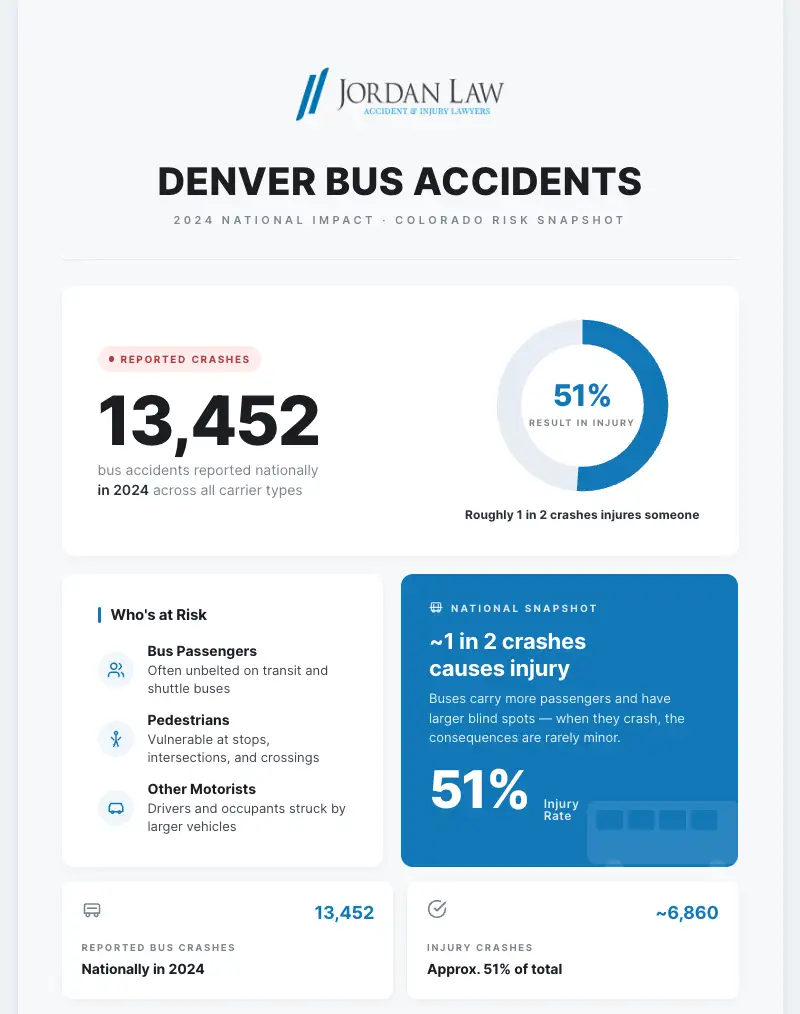
13,452
For a free legal consultation with a Personal Injury lawyer serving Denver, call (303) 465-8733
The 182-Day Deadline: Why Bus Accident Claims Can’t Wait
This is the single most important thing to understand about bus accident cases in Denver: if the bus was operated by RTD, a school district, a city, or any other government entity, you have only 182 days from the date of the accident to file a written notice of claim under Colorado’s Governmental Immunity Act (CGIA). Miss this deadline, and your right to compensation is gone — permanently.
⚠ Critical: 182-Day Government Claim Deadline
Under Colorado’s Governmental Immunity Act (C.R.S. § 24-10-109), you must file a formal written notice of claim within 182 days of the accident when a government entity is involved. This applies to all RTD bus and light rail accidents, school bus crashes, city-operated transit, and any collision involving a government-owned vehicle.
The notice must include specific information: your name and address, a detailed factual statement including the date, time, place, and circumstances of the accident, the names of any public employees involved, a description of your injuries, and the amount of damages you’re requesting.
This deadline is strictly enforced. Colorado courts have consistently held that failing to file timely notice is an absolute bar to your lawsuit — no exceptions. Contact a bus accident attorney immediately.
Compare this to a standard personal injury claim in Colorado, where you have three years. The 182-day CGIA deadline is less than half a year — and it starts running from the date of the accident, not from when you hire an attorney or finish medical treatment. Many bus accident victims don’t even realize this deadline exists until it’s too late.
There’s another critical limitation: the CGIA caps the amount you can recover from a government entity at $387,000 per person (adjusted every four years for inflation). While this cap can feel inadequate for serious injuries, an experienced attorney can identify additional sources of compensation — including claims against non-government parties, your own UM/UIM coverage, and MedPay — to maximize your total recovery.
“Nobody plans on getting into an accident, and all of a sudden you’re left with what to do. And oftentimes people, they don’t want to be that person. They don’t want to hire an attorney, so they think they’ll try to handle it on their own. They’ll make a lot of these mistakes along the way thinking that they’re doing the right thing when really the insurance company is taking advantage of the fact that you don’t have an attorney representing you.”
Jason Jordan, Esq. – Founding Partner, Jordan Law
RTD Bus Accidents in Denver
RTD is the backbone of Denver’s public transit system, serving a population of 3.08 million people across 2,342 square miles. In 2024, RTD buses and trains provided nearly 40 million miles of revenue service. With that volume of service comes a significant number of accidents — and RTD’s own data shows that safety challenges persist despite improvement efforts.
RTD bus accidents can involve passengers who are injured on the bus due to sudden stops, hard braking, or collisions; pedestrians who are struck by buses at stops, crosswalks, or intersections; cyclists who are hit by buses on shared roadways; and occupants of other vehicles who are involved in collisions with RTD buses. Each of these scenarios raises different legal issues, but they all share one thing in common: RTD is a public entity, which means the 182-day CGIA notice deadline applies to every claim.
Jordan Law has direct experience with RTD accident claims. Jason Jordan secured a $1.8 million settlement for a pedestrian who was struck by a 16th Street Mall bus — one of the RTD-operated free shuttle buses that run through downtown Denver. These cases require both an understanding of government liability law and a willingness to take on a public agency that will aggressively defend itself.
Common Carrier Liability
RTD and other bus operators are classified as “common carriers” under Colorado law. This legal designation is significant because common carriers owe their passengers a heightened duty of care — higher than what an ordinary driver owes other motorists. A common carrier must exercise the highest degree of care consistent with the practical operation of their vehicles. When an RTD bus driver fails to meet this elevated standard — by driving while distracted, failing to yield, running a red light, or otherwise being negligent — RTD can be held liable for passenger injuries.
This heightened standard also applies to conditions inside the bus. If a passenger is injured because the bus accelerated or braked suddenly without warning, because handrails or grab bars were broken, or because the bus floor was slippery and unaddressed, the common carrier duty of care can support a negligence claim.
Denver Bus Accident Lawyer Near Me (303) 465-8733
Types of Bus Accident Cases We Handle
Bus accidents come in many forms, and the legal approach varies significantly depending on who was involved and what caused the crash. Our Denver bus accident lawyers handle:
RTD Bus and Light Rail Accidents
Claims involving Denver’s public transit system, including fixed-route buses, the Free MallRide and MetroRide shuttles, and light rail collisions. These claims require CGIA compliance and an understanding of RTD’s operational structure.
School Bus Accidents
When a child is injured on a school bus, the emotional stakes are as high as the legal complexity. School bus operators — whether the school district itself or a contracted private company — may both be liable. If a school district is involved, CGIA notice rules apply. Colorado school bus safety laws impose additional requirements on drivers, including specific loading and unloading procedures.
Private Charter and Tour Bus Accidents
Private bus companies, including charter services, tour operators, and intercity coaches, are regulated under the Federal Motor Carrier Safety Administration (FMCSA). These companies must maintain proper insurance, adhere to driver hour-of-service regulations, and keep their vehicles in safe mechanical condition. When they fail, they can be held liable under both federal and state law.
Rideshare Shuttle and Airport Shuttle Accidents
Denver International Airport generates significant shuttle bus traffic. Hotel shuttles, rental car shuttles, and private airport transportation services all owe their passengers a duty of care. When shuttle operators are negligent, passengers have a right to pursue compensation.
Pedestrian and Cyclist Accidents Involving Buses
You don’t have to be on the bus to be a victim. Pedestrians and cyclists struck by buses often suffer the most severe injuries because they have no protection from the impact of a 12-ton vehicle. These cases are straightforward in terms of proving injury severity, but liability and government immunity issues can complicate recovery.
How We Build a Bus Accident Case
Bus accident cases require fast, aggressive investigation — particularly when a government entity is involved and the 182-day clock is ticking. Here’s how our team approaches these claims:
Immediate CGIA Notice Filing
For any bus accident involving RTD, a school district, or another government entity, our first priority is preparing and filing the required notice of claim under the Colorado Governmental Immunity Act. This notice must include specific factual details and be delivered by certified mail within the 182-day deadline. We handle this immediately so you don’t lose your right to compensation.
Evidence Preservation
Buses are increasingly equipped with surveillance cameras, GPS tracking, and event data recorders. RTD buses now have live look-in cameras and operator shield barriers. We send preservation demands immediately to ensure that video footage, maintenance records, driver logs, and electronic data are not overwritten or destroyed.
Identifying All Liable Parties
Bus accidents often involve multiple responsible parties. We investigate whether liability extends to the bus driver, the transit authority or bus company, a third-party maintenance contractor, another driver who caused the collision, or a government entity responsible for road design or maintenance. Identifying every liable party is critical to maximizing your recovery — especially when government damage caps limit what you can collect from one source.
“Cases start at a zero value. Just because you’re in a crash doesn’t mean you get anything. Building up your case is how we help you recover compensation for what you’ve been through. And so when I say let’s build up this case, it means let’s make sure this person gets the medical care they need. Let’s make sure they’re taken care of on the medical side, but on the pain and suffering side too. We need to build up that story to show an insurance company who does not care about individuals that they need to pay money for this.”
Sarah Freedman, Esq. – Director of Pre-litigation, Jordan Law
Insurance Coverage Analysis
Bus accident claims often involve layered insurance. We review the bus company’s commercial policy, any government self-insurance or risk pool, other at-fault drivers’ liability coverage, your own UM/UIM and MedPay coverage, and any umbrella policies. When government damage caps limit one source of recovery, your own insurance coverage becomes especially important.
“Colorado has one of the highest percentages of people driving around with no insurance. Uninsured or underinsured motorist coverage is coverage that you get to protect yourself and your family. I call it “you coverage” because it is coverage for you. People don’t always understand that by protecting themselves, they’re hedging their bets that the people out there driving around who can’t be trusted have good insurance — which they usually don’t.”
Sarah Freedman, Esq. – Director of Pre-litigation, Jordan Law
Medical Documentation and Treatment Coordination
Bus accidents frequently cause serious injuries — traumatic brain injuries, spinal cord damage, crush injuries, and severe fractures. We coordinate with your medical providers to ensure your injuries are thoroughly documented and that you’re receiving appropriate specialist care. As Sarah Freedman explains: “A treatment gap is when you stop going to medical care or you never start, and it creates a time period where there’s no evidence of your injury. An insurance company is going to use that against you later on.”
Click to contact our personal injury lawyers today
Compensation Available to Bus Accident Victims
Colorado is an at-fault state, which means the party responsible for the bus accident — and their insurer — is responsible for your damages. Bus accident victims may recover compensation for:
Medical expenses — emergency room care, surgery, hospitalization, rehabilitation, physical therapy, and all future medical treatment related to your injuries.
Lost wages and earning capacity — income lost during recovery and, in severe injury cases, diminished ability to earn income in the future.
Pain and suffering — physical pain, emotional distress, anxiety, and diminished quality of life.
Property damage — repair or replacement of your vehicle if you were in another car that was struck by a bus.
Loss of enjoyment of life — compensation for activities, relationships, and daily pleasures that the injury has taken from you.
Government Damage Caps
When RTD or another government entity is liable, the Colorado Governmental Immunity Act caps recovery at $387,000 per person (adjusted for inflation every four years). This cap applies only to the government entity — it does not limit what you can recover from other liable parties, your own insurance, or through other legal theories. An experienced bus accident lawyer will explore every avenue to maximize your total recovery beyond this cap.
“You retain an attorney and that just takes all of that away. And we tell you what all those things mean — like collateral source and subrogation and common fund doctrine and ERISA plans as opposed to state funded plans and why that matters to you at the end of the day. We explain those things to you and then you go back to work and you live your life and you see your medical doctors. That’s what we’re here for.”
Jason Jordan, Esq.Founding Partner, Jordan Law
What to Do After a Bus Accident in Denver
Get Medical Attention Immediately
Bus accidents produce violent forces — sudden stops, impacts with seats and handrails, ejection from seating. Even if you feel okay at the scene, get evaluated by a doctor. Brain injuries, internal bleeding, and spinal injuries may not show symptoms immediately. Your medical records from day one become critical evidence.
Report the Accident
Make sure a police report is filed. For RTD accidents, the transit authority will create its own incident report — but you should also independently file a report with Denver police. Get the report number, as you’ll need it for your insurance claim and any legal action.
Document Everything
If you’re physically able, take photos and video of the bus, the scene, your injuries, and any hazardous conditions (wet floors, broken handrails, obstructed views). Get contact information from witnesses. Note the bus number, route, driver name or badge number, and the exact time and location.
Do Not Give Recorded Statements
RTD’s risk management department and any involved insurance companies will begin investigating quickly. Do not give a recorded statement to anyone without first consulting an attorney. As Jason Jordan warns about insurance companies: “Wait till you go to the claims department. You’re not dealing with the salesperson anymore. You’re dealing with the people who are having to pay the money back out. Maybe not so surprisingly, they might not treat you very well.”
Contact a Bus Accident Lawyer Immediately
The 182-day CGIA deadline makes speed essential. An attorney can file your notice of claim, send evidence preservation demands, begin investigating the accident, and protect you from making early mistakes that could compromise your case. Every day that passes without legal representation is a day closer to losing your rights.
Complete a Free Case Evaluation form now
Why Jordan Law for Your Bus Accident Case
Government liability experience. Suing RTD or another public entity is fundamentally different from a standard personal injury claim. We know how to navigate the CGIA, file proper notice, work within damage caps, and identify every source of additional compensation available to you.
Proven bus accident results. Jason Jordan secured a $1.8 million settlement for a pedestrian struck by a 16th Street Mall bus — demonstrating our ability to achieve strong results even within the framework of government liability claims.
True trial lawyers. Insurance companies and government risk managers negotiate differently when they know the attorneys on the other side are prepared to go to court. Our trial record ensures your case is taken seriously from day one.
We move fast. With a 182-day deadline, there’s no time for delays. We file CGIA notices, send preservation demands, and begin investigation immediately — often within the first days of representation.
No fee unless we win. We handle bus accident cases on a contingency fee basis. You pay nothing upfront, and we only get paid if we recover compensation for you.
We represent bus accident victims across Denver, Aurora, Centennial, Englewood, Littleton, Boulder, Colorado Springs, and throughout Colorado.
Frequently Asked Bus Accident Questions
How long do I have to file a claim after an RTD bus accident?
Because RTD is a government entity, you must file a written notice of claim within 182 days (approximately 6 months) of the bus accident under Colorado’s Governmental Immunity Act (C.R.S. § 24-10-109). This is much shorter than the standard 3-year statute of limitations for personal injury claims. The notice must include specific factual details and be delivered by certified mail. Missing this deadline permanently bars your claim. Contact an attorney immediately to ensure your notice is filed correctly and on time.
Who is liable in a Denver bus accident?
Liability depends on the circumstances. Potentially liable parties include the bus driver, the bus company or transit authority (such as RTD), a third-party maintenance contractor, another driver who caused the collision, or a government entity responsible for road conditions. In many cases, multiple parties share fault. Colorado follows a modified comparative negligence rule, meaning your compensation may be reduced by your percentage of fault — but only if you’re less than 50% responsible. Jordan Law thoroughly investigates every bus accident to identify all liable parties.
What compensation can I recover after a bus accident?
Bus accident victims can seek compensation for medical expenses, lost wages, pain and suffering, emotional distress, and property damage. However, claims against government entities like RTD are subject to damage caps under the CGIA — currently $387,000 per person. Additional compensation may be available from other liable parties, your own UM/UIM coverage, MedPay, or through other legal theories. An experienced attorney will identify every available source of recovery.
What is the common carrier standard of care?
Bus companies and transit authorities like RTD are classified as “common carriers” under Colorado law. This means they owe passengers a heightened duty of care — higher than what an ordinary driver owes. Common carriers must exercise the highest degree of care consistent with the practical operation of their vehicles. When they fail to meet this standard and a passenger is injured, they can be held liable. This heightened standard also applies to conditions inside the bus, such as broken handrails, slippery floors, or sudden acceleration without warning.
What if I was a pedestrian or in another vehicle hit by a bus?
You don’t have to be a bus passenger to have a claim. Pedestrians, cyclists, and occupants of other vehicles who are injured by a negligent bus driver can pursue compensation. These claims follow standard negligence principles — you need to show the bus driver or operator was at fault. If the bus is operated by a government entity like RTD, the 182-day CGIA notice deadline still applies regardless of whether you were a passenger or not.
How much does it cost to hire a bus accident lawyer?
Jordan Law handles bus accident cases on a contingency fee basis. You pay nothing upfront and owe no attorney fees unless we recover compensation for you. Your initial consultation is always free, with no obligation. Given the short 182-day deadline for government claims, we strongly recommend consulting an attorney as soon as possible after a bus accident.
Our Colorado Location
Our office is located in the Denver Tech Center at 5445 DTC Parkway, Suite 1000, Greenwood Village, CO 80111.