


Injured by a Drunk Driver? We Fight for You.
When an impaired driver destroys your health, your livelihood, and your sense of safety, you deserve attorneys who will hold them accountable. Jordan Law has recovered over $550 million for injured victims. We prepare every case as if it will go to trial — because that’s how real results are achieved.
For a free legal consultation with a Personal Injury lawyer serving Denver, call (303) 465-8733
Denver Drunk Driving Accidents: A Preventable Crisis
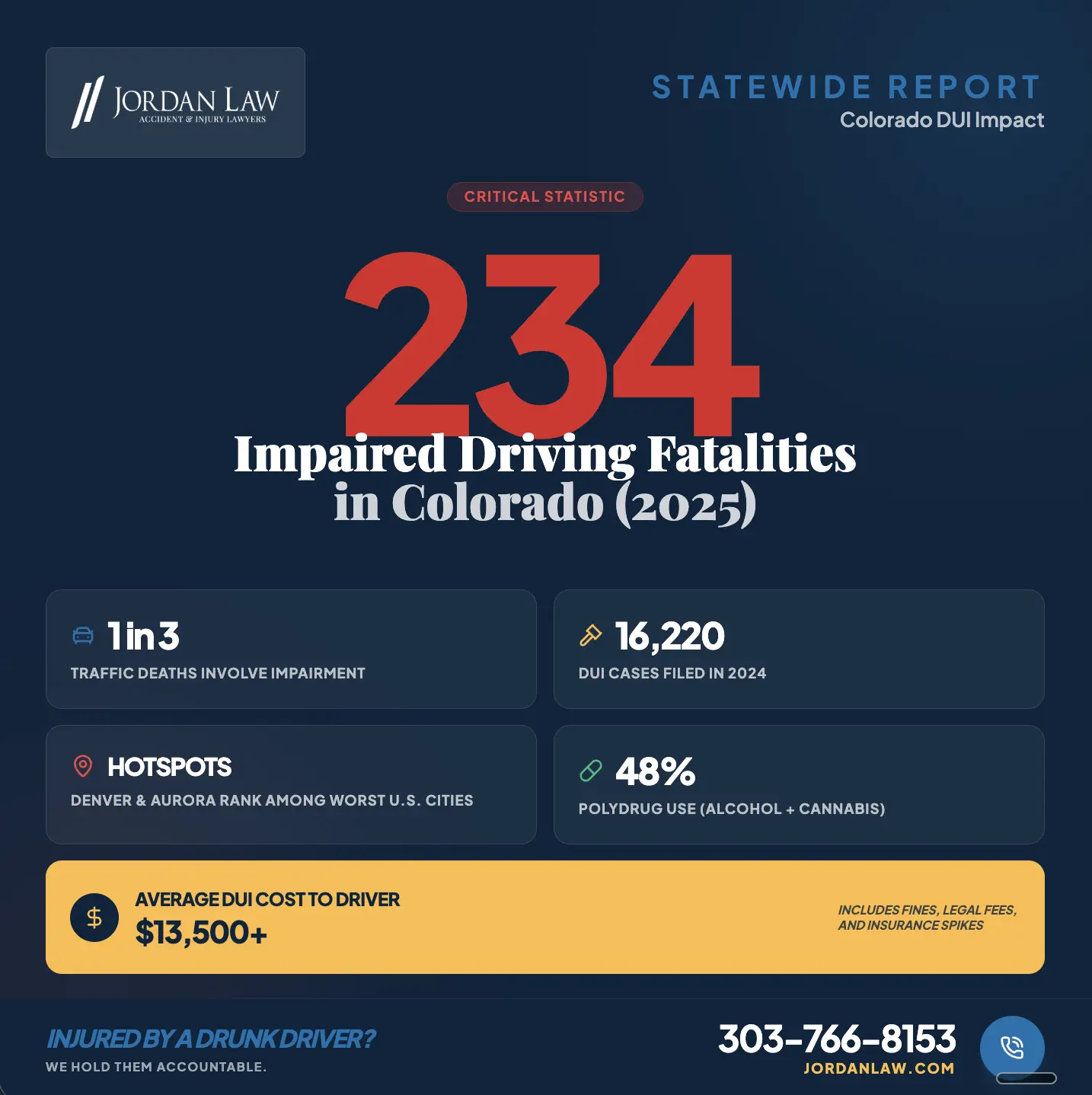
Drunk driving crashes are not accidents. They are the predictable result of someone choosing to get behind the wheel after drinking. And in Colorado, the consequences are devastating. According to the Colorado Department of Transportation, 234 people died in crashes involving an impaired driver in 2025 alone — and 34% of all traffic fatalities in the state involved a driver under the influence of drugs or alcohol. If you lost a loved one in a fatal car crash, our Denver fatal car accident lawyers can help your family pursue a wrongful death claim.
Denver and Aurora consistently rank among the worst cities in the country for drunk driving incidents. The corridors along I-25, I-70, and I-225 see a disproportionate share of impaired driving crashes, particularly during holiday weekends, summer months, and late-night hours. If you or a family member has been hurt by a drunk driver anywhere in the Denver metro area, you need an attorney who understands both the legal complexity and the human toll of these cases.
At Jordan Law, our Denver drunk driving accident lawyers represent victims of DUI crashes throughout Colorado. We handle serious injury claims against impaired drivers, and when applicable, against the bars, restaurants, and social hosts who served them. We’re not a settlement mill — we’re trial lawyers who prepare every case with the depth and rigor it deserves.
1 in 3
Why Drunk Driving Injury Cases Are Different
Drunk driving crashes typically produce more severe injuries than other motor vehicle collisions. Impaired drivers are more likely to be speeding, running red lights, driving the wrong way, or failing to brake entirely. The resulting impacts tend to be high-speed and high-force, leading to catastrophic injuries including traumatic brain injuries, spinal cord damage, severe burns, and wrongful death.
But what makes these cases legally distinct is the element of intentional recklessness. A drunk driver made a conscious choice to drink and then drive. That decision opens the door to forms of compensation that aren’t available in ordinary negligence cases — most notably, punitive damages.
Punitive Damages in Colorado DUI Crash Cases
Colorado law allows courts to award punitive damages when the at-fault party’s conduct was willful and wanton — a legal standard that drunk driving often meets. Punitive damages go beyond compensating you for your losses. They’re designed to punish the wrongdoer and deter others from similar conduct. In drunk driving cases, this can significantly increase the total recovery available to victims and their families.
Dram Shop Liability: Holding Bars and Restaurants Accountable
Under Colorado’s Dram Shop Law (C.R.S. § 12-47-801), you may have a claim not only against the drunk driver but also against the establishment that served them. If a bar, restaurant, or liquor store sold alcohol to someone who was visibly intoxicated — or to a minor — and that person then caused a crash, the establishment can be held liable for your injuries.
Jordan Law has experience with these complex multi-defendant cases. Our $131 million verdict involved a situation where a driver was over-served at a restaurant and bar, resulting in a catastrophic car accident. These cases require thorough investigation, including obtaining service records, surveillance footage, and witness testimony before evidence is lost or destroyed.
“Nobody plans on getting into a car accident, and all of a sudden you’re left with what to do. And oftentimes people, they don’t want to be that person. They don’t want to hire an attorney, so they think they’ll try to handle it on their own. They’ll call up an insurance company, and maybe they’ll even give a recorded statement when they shouldn’t and they don’t have to. They’ll sign a medical release authorization with the other side’s company, which they shouldn’t and they don’t have to. They’ll make a lot of these mistakes along the way thinking that they’re doing the right thing when really the insurance company is taking advantage of the fact that you don’t have an attorney representing you.”
Jason Jordan, Esq. – Founding Partner, Jordan Law
Denver Car Accident Lawyer Near Me (303) 465-8733
How We Build a Drunk Driving Accident Case
Drunk driving cases demand aggressive, early investigation. Evidence can disappear quickly — surveillance footage gets overwritten, blood alcohol test results can be challenged, and the criminal case against the driver may move on a separate track from your civil claim. At Jordan Law, we move immediately to preserve evidence, identify all liable parties, and build the strongest possible case for compensation.
“Cases start at a zero value. Just because you’re in a crash doesn’t mean you automatically get something. Building up your case is how we help you recover compensation for what you’ve been through. Building up means documenting, it means notating, it means just preparing to present a case, and ideally we do that so that we can get you a settlement. But we do it in such a way that if an insurance company doesn’t take it seriously, we are prepared to take your case as far as we need, which can include trial.”
Sarah Freedman, Esq. – Director of Pre-litigation, Jordan Law
Immediate Investigation
We work to secure the police report, BAC test results, toxicology reports, dashcam or body camera footage, and any criminal court filings against the at-fault driver. If a bar or restaurant is involved, we send preservation letters immediately to prevent surveillance footage, receipts, and serving records from being destroyed.
Insurance Analysis
Drunk drivers often carry minimal insurance — or none at all. We conduct a thorough review of every available insurance policy, including the at-fault driver’s liability coverage, your own uninsured/underinsured motorist (UM/UIM) coverage, medical payments (MedPay) coverage, and any commercial policies if the driver was working at the time of the crash.
“Colorado has one of the highest percentages of people driving around with no insurance. Uninsured or underinsured motorist coverage is coverage that you get to protect yourself and your family. I call it “you coverage” because it is coverage for you. It happens all the time where you get hit by someone who has kind of crappy insurance, state minimum insurance, and you didn’t protect yourself, and that means that’s all there is.”
Sarah Freedman, Esq. – Dir. of Pre-litigation, Jordan Law
Medical Documentation
We coordinate with your medical providers to ensure your injuries are thoroughly documented and that treatment gaps don’t undermine your claim. As Sarah Freedman explains: “A treatment gap is when you stop going to medical care or you never start, and it creates a time period where there’s no evidence of your injury. An insurance company is going to use that against you later on.”
Demand and Negotiation
Once your medical treatment stabilizes, we assemble a comprehensive demand package including all medical records, bills, wage loss documentation, and a detailed accounting of your pain and suffering. We negotiate aggressively with the insurance companies — and if they refuse to make a fair offer, we’re fully prepared to take your case to trial.
$13,500+
Click to contact our personal injury lawyers today
What You Should Do After a Drunk Driving Crash
The aftermath of a drunk driving accident is overwhelming. You’re in pain, you’re angry, and you may not know where to start. Here’s what our attorneys recommend:
Get Medical Attention Immediately
Even if you feel able to walk away from the scene, some of the most serious injuries — traumatic brain injuries, internal bleeding, spinal injuries — may not show symptoms right away. Go to the emergency room or urgent care. Your medical records from day one become critical evidence in your case.
Do Not Give Recorded Statements
The at-fault driver’s insurance company may contact you quickly, sometimes within hours. As Jason Jordan warns: “I have people tell me all the time, ‘I’ve been dealing with this insurance company for 20 years and they’ve always treated me great.’ And I say, ‘Have you ever made a claim?’ And they say, ‘No.’ Well, okay. So the person taking your money has been treating you great. Wait till you go to the claims department.”
Do not give a recorded statement. Do not sign a medical release authorization. These are tools the insurance company uses to limit what they pay you, not to help you.
Contact a Drunk Driving Accident Lawyer
The sooner you have an attorney involved, the better your case will be. We can send preservation letters, begin gathering evidence, handle all insurance communications, and make sure you don’t make early mistakes that cost you later.
“You retain an attorney and that just takes all of that away. And we tell you what all those things mean — like collateral source and subrogation and common fund doctrine and ERISA plans as opposed to state funded plans and why that matters to you at the end of the day. We explain those things to you and then you go back to work and you live your life and you see your medical doctors. That’s what we’re here for.”
Jason Jordan, Esq. – Founding Partner, Jordan Law
Compensation Available to Drunk Driving Accident Victims
Victims of drunk driving crashes in Colorado may be entitled to recover compensation for a wide range of damages, including:
Medical expenses — emergency room visits, surgeries, hospitalization, rehabilitation, physical therapy, prescription medications, and all future medical care related to your injuries.
Lost wages and earning capacity — compensation for time missed from work during recovery and, in catastrophic injury cases, for diminished ability to earn income in the future.
Pain and suffering — the physical pain, emotional distress, anxiety, depression, and loss of enjoyment of life caused by the crash and your injuries.
Property damage — repair or replacement of your vehicle and personal property.
Punitive damages — additional damages available in DUI crash cases to punish the drunk driver’s reckless conduct and deter similar behavior.
Wrongful death damages — if you lost a loved one to a drunk driver, Colorado law allows surviving family members to seek compensation for funeral and burial expenses, loss of income, loss of companionship, and grief.
“What I like to tell clients is the best thing they can do for their case: one, trust us. Two, give us as much information as you can. Tell us how you’re feeling. Tell us how medical visits are going. Tell us what life is like at home because of your injuries. We really want you to share that kind of information with us because it helps us do our job better. It helps us understand your story in the sense that we can tell other people what you’ve been through — tell the jury one day what you’ve been through, tell an insurance adjuster or an attorney on the other side, hey, this is what my clients are going through on a daily basis.”
Michael Harris, Esq. – Litigation Attorney, Jordan Law
Complete a Free Case Evaluation form now
Why Jordan Law for Your Drunk Driving Accident Case
Not every personal injury firm is equipped to handle the complexity of a drunk driving case — especially when dram shop claims, criminal proceedings, and catastrophic injuries are involved. Here’s why victims and their families choose Jordan Law:
True trial lawyers. Insurance companies track which firms actually go to court. When your attorneys have a reputation for trying cases, negotiations change — and lowball offers tend to disappear. As Jason Jordan puts it: “The insurance carriers know which law firms try cases and you get better value on your case if you’re with a law firm that the insurance companies respect as true trial lawyers.”
Proven results in DUI cases. Our $131 million verdict arose from a case where a driver was over-served at a restaurant — exactly the kind of complex, multi-party drunk driving case that requires deep experience and willingness to fight.
Personalized attention. We’re not a volume firm. We limit our caseload so every client gets direct attorney involvement, clear communication, and a real strategy — not vague promises.
No fee unless we win. We work on a contingency fee basis. You pay nothing upfront, and we only get paid if we recover compensation for you. Consultations are always free.
Our office is located in the Denver Tech Center at 5445 DTC Parkway, Suite 1000, Greenwood Village, CO 80111.
We represent drunk driving accident victims across Denver, Aurora, Centennial, Englewood, Littleton, Lakewood, and throughout Colorado.
Hurt by a Drunk Driver? Talk to Us Today.
Consultations are free. There’s no obligation — and no fee unless we win. Even if you don’t hire us, we’ll point you toward attorneys we trust.
Hesitant to Call a Lawyer?
Don’t be. Many people who need a personal injury lawyer wait too long to call one — not because they don’t need help, but because they’re intimidated, overwhelmed, or afraid of doing something “wrong.” At Jordan Law, attorney Sarah Freedman sees this every day.
Calling an attorney is easy and shouldn’t cause stress. A free consultation is simply a conversation — we can do it in person, on the phone, or via Zoom. We want to know what happened and whether we can help. If we can, great. If not, we’ll tell you honestly and recommend other attorneys we trust. Learn more about what to expect.
Frequently Asked Questions
Can I sue a drunk driver for my injuries in Colorado?
Yes. If a drunk driver caused your injuries, you can file a personal injury claim against them seeking compensation for medical bills, lost wages, pain and suffering, and other damages. Colorado also allows punitive damages in drunk driving cases, which are meant to punish especially reckless behavior. The civil case is separate from any criminal charges the driver may face.
Can I also sue the bar or restaurant that served the drunk driver?
Under Colorado’s Dram Shop Law (C.R.S. § 12-47-801), you may be able to file a claim against a bar, restaurant, or liquor store that served alcohol to a visibly intoxicated person or to a minor who then caused your crash. These cases require proving the establishment knew or should have known the person was impaired. Jordan Law has experience with these complex multi-party claims — our $131 million verdict involved an over-served driver.
What compensation can I recover after a drunk driving accident?
Victims can seek compensation for medical expenses (current and future), lost wages and loss of earning capacity, pain and suffering, emotional distress, property damage, and loss of enjoyment of life. Colorado also allows punitive damages in DUI crash cases to punish the at-fault driver’s reckless conduct. In wrongful death cases, surviving family members can seek additional damages for loss of companionship and grief.
What is the statute of limitations for a drunk driving accident claim in Colorado?
In Colorado, you generally have three years from the date of the accident to file a personal injury claim. For wrongful death claims arising from a fatal drunk driving crash, the statute of limitations is two years. Missing these deadlines can permanently bar your right to recover compensation, so it’s important to contact an attorney as soon as possible.
What if the drunk driver had no insurance or minimal coverage?
This is unfortunately common in Colorado. If the drunk driver lacks adequate insurance, your own uninsured or underinsured motorist (UM/UIM) coverage may apply. Jordan Law conducts a thorough review of every available policy — the at-fault driver’s coverage, your own UM/UIM, MedPay, and any commercial policies — to identify every source of compensation available to you.
How much does it cost to hire a drunk driving accident lawyer?
Jordan Law handles drunk driving accident cases on a contingency fee basis, meaning you pay nothing upfront and owe no attorney fees unless we recover compensation for you. Your initial consultation is always free, with no obligation. If we take your case, our fee is a percentage of the recovery — so our incentives are fully aligned with yours.